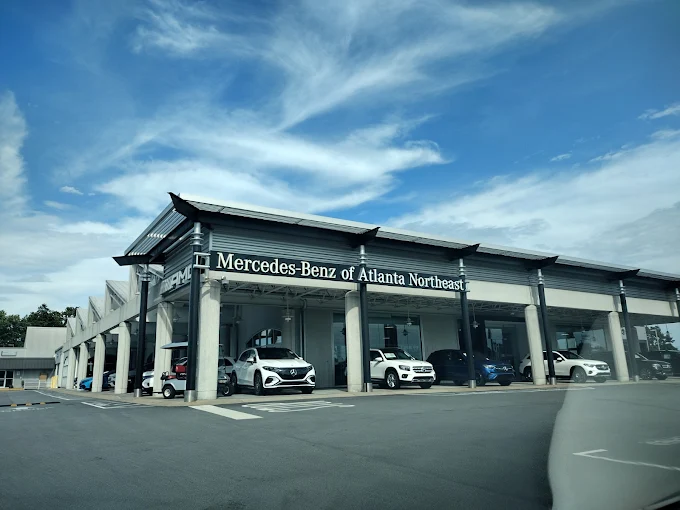


Your Mercedes-Benz Brake System Has a Wear-Indicator Light. That Light Is Not the Starting Point.
Posted at Fri, Sep 25, 2026 1:31 AM
Mercedes specifies DOT 4 Plus brake fluid (meeting internal spec MB 331.0) for its current lineup. Standard DOT 4 lowers the boiling threshold inside the hydraulic circuit and compromises the low-viscosity requirement that makes modern ABS and ESP response times possible.
The brake pad wear sensor in your Mercedes-Benz GLE (and virtually every other current Mercedes-Benz) is engineered to trigger a dash warning at roughly 2 to 3 mm of friction material remaining. That's not much runway. It was never meant to be the signal that prompts you to book a service appointment two weeks before you pack the car for Thanksgiving. Think of it as a final notice. The serious check belongs in the pre-holiday window, right now.
October and November in metro Atlanta wear on brake systems, and they do it without much fanfare. GA-400 mountain runs to Blue Ridge and Dahlonega heat rotors hard on those long descents. Then the same owners come back to weekday commutes on I-85 through Duluth and the afternoon crawl on I-285. Repeated thermal cycling degrades pads unevenly, glazes rotor surfaces, and speeds up moisture absorption in brake fluid. By the time holiday trip volume peaks, a system that felt fine in August can read differently under sustained load.
What does our service center actually check? We look at pad depth, rotor thickness, and fluid condition, we explain why the fluid spec isn't a footnote, and we sort out who genuinely needs to act before the holidays from who can keep monitoring.
What the Specs Actually Mean for Your Stopping Distance
A brake inspection on a Mercedes-Benz isn't a pass/fail on pad depth alone, and treating it that way misses most of the picture. There are four measurable parameters our technicians assess at every pre-trip check.
| Brake Component | What We Measure | Action Threshold |
|---|---|---|
| Front brake pad friction material | Remaining lining thickness (mm) | Mercedes WIS: wear-indicator light activates at 2-3 mm remaining |
| Rear brake pad friction material | Remaining lining thickness (mm) | Same sensor logic; rear wear often lags front by 20-30% on sedan/SUV models |
| Rotor thickness | Micrometer measurement vs. stamped minimum on rotor hat | Minimum is model-specific and stamped on the rotor; a rotor below minimum cannot reliably absorb heat |
| Brake fluid moisture content | Boiling point test strip or refractometer | Mercedes specifies DOT 4 Plus (MB 331.0); wet boiling point of 180C (356F) vs. standard DOT 4's 155C (311F) |
That last row is the one drivers most consistently underestimate. Brake fluid is hygroscopic, meaning it draws moisture from the air over time. As water content rises, the wet boiling point drops. Per Mercedes technical specification MB 331.0, the correct fluid is DOT 4 Plus, a low-viscosity formulation with a wet boiling point of 180C. Standard DOT 4 sits at 155C. That 25-degree gap is the difference between consistent pedal feel and the early onset of vapor lock during a sustained downhill braking sequence on a loaded GLE or Mercedes-Benz GLS.
The low-viscosity requirement matters just as much. Mercedes engineers the DOT 4 Plus spec (ISO 4925 Class 6, roughly 750 mm2/s maximum viscosity at -40C) so the ABS and ESP solenoids can cycle fast enough to do their job. Thicker fluid slows that response. You'd never feel the difference on a dry Atlanta surface at 40 mph. You'd notice it the moment the system has to work hard.
Why Atlanta's Driving Pattern Creates a Specific Wear Profile
Stop-and-go commuting on I-285 and mountain runs are hard on brake systems in different ways, and our market imposes both. That combination is the part owners rarely account for, and it's also the part that shows up first on a micrometer.
City driving generates frequent low-energy brake applications. That cycle keeps rotors and pads in constant use but rarely builds extreme heat in a single event. What it does generate is rotor surface corrosion from overnight cooling, and Georgia's damp fall mornings make it worse, plus uneven pad bedding if the vehicle sits over a weekend with residual heat still in the system.
Weekend GA-400 runs to the North Georgia mountains do the opposite. Long, sustained downhill grades at speed build continuous thermal load in the rotor's venting channels. That thermal cycling can cause microscopic surface metallurgy changes in the rotor, and they show up as pedal vibration or slightly longer stopping distances before anything is visible on inspection.
What our service team watches for: Our Duluth service lane sees a mismatched wear pattern on cars that split their time between the I-285 commute and regular mountain trips: fresh-looking rear pads paired with front pads that are noticeably thinner. Front brakes carry approximately 70% of braking load during deceleration. The combination wears fronts faster than owners expect.
The practical takeaway is straightforward. If your Mercedes-Benz C-Class sedan, GLC, or larger SUV has covered 15,000 miles or more since its last brake service, and that mileage includes any regular mix of commute and mountain driving, a visual measurement check before the holiday window is the right call. Not because something is necessarily wrong. Because you want to know the numbers before traffic volume triples.
Schedule a Pre-Holiday Brake Inspection
Pros and Cons of Addressing Brakes Before the Holidays vs. After
| Pros (Inspect Now) | Cons (Inspect Now) |
|---|---|
| Service bay availability is better before November | You may find pads with 4-5 mm remaining, meaning action is premature |
| Any parts on order arrive before your departure date | A short wait before acting is fine if numbers are solid |
| Fluid condition check catches moisture buildup before it matters under load | An inspection has a real time cost |
| Our technicians can calibrate the wear sensor correctly after any service | Scheduling takes planning during a busy fall season |
Here's the honest calculus. If your last brake service was over two years ago regardless of miles (brake fluid's moisture absorption is time-driven, not just mileage-driven), that fluid check alone is worth the visit. And if you're under a year out from a full service, a visual check during any other scheduled service will do the job.
Who Needs to Act Now and Who Can Monitor
The answer depends on three things, and they're worth weighing together: mileage since your last service, your driving profile, and whether you're planning a long highway trip. None of the three tells the whole story alone.
Act before the holidays if:
- You're approaching 25,000 to 30,000 miles without a brake service (pad wear on this driving profile typically begins entering the caution range)
- Your brake fluid hasn't been replaced in two years or more (moisture absorption is time-dependent regardless of pad condition)
- You've noticed any pedal feel change, vibration through the wheel under braking, or a soft pedal that firms up with a second pump
- Your trip includes sustained mountain driving with a full load (passengers plus luggage adds meaningful braking demand on downhill grades)
Continue monitoring if:
- Your last full brake service was within 12 months and under 15,000 miles
- You drive primarily on flat highway and surface roads with no mountain descents
- No dash warning is present and pedal feel is firm and consistent
The wear-indicator system on a current Mercedes-Benz is reliable. When it triggers, the sensor grounds against the rotor and lights up the dash. It's a precise signal. What it can't tell you is where you sit in the 4 mm to 2 mm range before it fires, and it says nothing about fluid moisture or rotor thickness variation. Those need a technician with a micrometer and a fluid test strip.
The Mercedes-Benz GLC and larger SUVs in our lineup are worth a closer look before a loaded holiday run, simply because higher curb weight amplifies braking demand. A GLS loaded with five adults and luggage asks meaningfully more of its brake system on a mountain descent than the same vehicle commuting solo on I-285.
Our service center team is here to run the full measurement set, not just a visual pass, and give you a factual read on where your system stands. It's the conversation worth having in late September rather than the week before Thanksgiving.
Frequently Asked Questions
How often does a Mercedes-Benz actually need a brake inspection?
Mercedes-Benz recommends a brake component inspection roughly every 10,000 to 12,000 miles or once a year, whichever comes first, as part of the Service A maintenance schedule. That inspection covers pad thickness, rotor condition, caliper function, and brake fluid. For drivers who mix daily stop-and-go commuting with occasional mountain runs, the front pads can approach the caution range before the mileage interval suggests. The inspection interval is a floor, not a ceiling.
Does my Mercedes-Benz require a special brake fluid, or can I use standard DOT 4?
It requires DOT 4 Plus meeting Mercedes internal specification MB 331.0, not standard DOT 4. The difference is viscosity and wet boiling point. DOT 4 Plus carries a wet boiling point of 180C versus standard DOT 4's 155C, and its low-viscosity formulation (ISO 4925 Class 6) lets the ABS and ESP solenoids cycle at the response speeds the system is designed for. Using standard DOT 4 won't cause immediate failure, but it lowers the hydraulic performance threshold that the vehicle's electronic safety systems depend on. Our service center uses only Mercedes-approved fluid.


