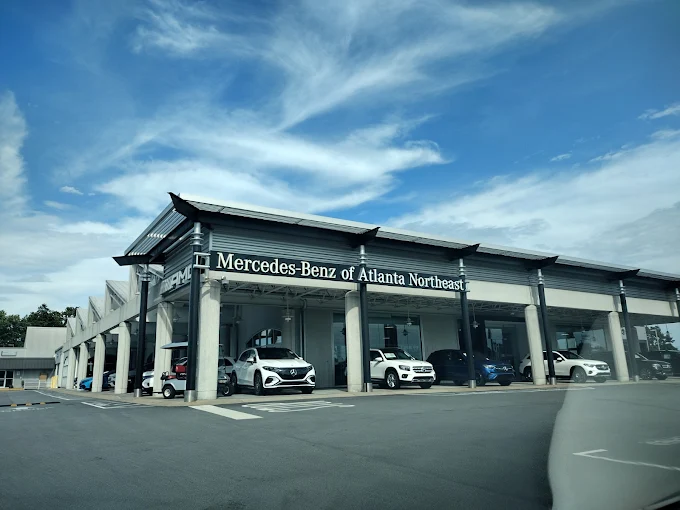


Your Battery Is Fine in August (and Other Things Duluth Mercedes Owners Get Wrong)
Posted at Tue, Aug 18, 2026 1:15 AM
August in the Atlanta metro is punishing this year, and the numbers back that up. The National Weather Service out of Peachtree City recorded a heat index of 105 to 110 degrees in the region this past week, with highs sitting in the mid-to-upper 90s and no meaningful relief in the forecast through late month. Heat like that does real, measurable damage to three systems on your Mercedes-Benz. Most owners are watching the wrong one.
The tire pressure light grabs your attention. Meanwhile the battery and the brake fluid do their damage quietly, invisibly, and at exactly the wrong moment.
The short version
- Myth: winter kills batteries; summer is easy on them. Reality: heat is the more aggressive threat to Mercedes-Benz AGM chemistry, according to Mercedes-Benz USA.
- Myth: a TPMS light in August means your tires are low. Reality: Georgia summer heat raises cold-inflation pressure, so adding air to a hot tire can create overpressure.
- Myth: brakes are a winter concern. Reality: brake fluid is hygroscopic, Georgia humidity speeds its degradation, and Mercedes specifies a two-year replacement interval regardless of season.
- All three systems deserve a look in August, not just your tires.
- One visit to our service center covers all three (no separate appointments required).
The three myths below are worth correcting before the heat corrects them for you. Expensively, on the side of I-85.
Is Summer Actually the Easy Season for Your Battery?
No, summer is not the easy season, and that runs against what most owners assume. Cold-weather failures are loud and obvious, but Georgia heat is the more aggressive threat to your Mercedes-Benz battery, aging the AGM chemistry from the inside while the car quietly compensates until the reserve is simply gone.
Cold-weather battery deaths are dramatic and obvious. You turn the key on a January morning, nothing happens, you call for a jump. Summer failure is slower. Mercedes-Benz USA describes exactly how this works with the AGM (Absorbed Glass Mat) batteries used across the modern lineup, where heat ages the battery while the vehicle's own systems compensate for the weakening, masking the damage until the battery can no longer hold a load. You can't see the problem by looking at it. By the time August arrives and you're running the climate control at maximum for your I-285 commute, a battery that "passed" last spring may be at the edge of its useful capacity.
The myth matters most right here. Hot-climate Mercedes-Benz owners sometimes see a three-to-four-year effective life rather than the five-year upper limit, because sustained heat accelerates the internal chemical reactions and, in conventional batteries, contributes to electrolyte loss. The AGM design is more resilient than a standard flooded battery, but it isn't immune. The fix is a proper load test, not a voltage glance.
| The Claim | What's Actually True |
|---|---|
| "Car batteries die in winter, not summer." | Mercedes-Benz USA confirms heat ages the battery by accelerating internal chemical reactions, masking damage until the load threshold is crossed. |
| "If it started this morning, the battery is fine." | A degraded AGM battery can crank the engine while carrying insufficient reserve for the full electrical load (MBUX, active safety systems, climate control) on short stop-and-go trips that prevent a full recharge cycle. |
| "I'll check it before winter." | A battery weakened by two Georgia summers may fail before you ever reach a cold morning. Professional load testing, not just a voltage read, is the correct diagnostic. |
| "The TPMS light means my tires are low." | In August heat, tire pressure rises as the air inside expands. A TPMS alert on a hot afternoon can reflect overpressure in a tire you already filled to spec that morning, or a sensor calibration issue, not necessarily an underinflation problem. |
| "Brakes are a cold-weather maintenance item." | Brake fluid is hygroscopic, absorbing ambient moisture year-round. Georgia's summer humidity accelerates that absorption, lowering the fluid's boiling point progressively. Mercedes-Benz USA specifies replacement every two years for exactly this reason. |
What August Heat Actually Does to Your Tires and Brakes in the Atlanta Area
August heat pushes on your tires and brakes in opposite directions. It expands the air in your tires until a TPMS light can mean overpressure rather than a leak, and it speeds the moisture that's been creeping into your brake fluid all year, dropping the fluid's boiling point right when Georgia's humidity is at its worst.
Tires. Check your Mercedes-Benz door jamb placard for the cold inflation pressure, the figure measured after the vehicle has sat for at least three hours or traveled under one mile. That number is the one that matters. On an Atlanta-area August afternoon, the pavement surface temperature along I-85 or GA-400 can run significantly above ambient air temperature, and the air inside your tires expands right along with it. A pattern our team runs into once the heat sets in is owners who check pressure at midday and add air to reach the door-jamb spec, then inadvertently overinflate, because the reading is warm rather than cold. The correct habit is a morning check, before any driving, against the placard number. Overinflated tires reduce the contact patch with the road, which shortens stopping distances in ways you'll feel most during a summer thunderstorm on Buford Highway.
Brakes. The fact most checklists leave out is simple. Brake fluid absorbs moisture from the atmosphere continuously, through microscopic pores in the rubber brake hoses. Mercedes-Benz USA specifies DOT 4 Plus brake fluid and a replacement interval of every two years or 20,000 miles. The reason is mechanical. After roughly two years of moisture absorption, the fluid's boiling point drops measurably. Under hard braking (an emergency stop on the highway, or the long deceleration on a GA-400 mountain run to Dahlonega) degraded fluid can form vapor bubbles in the brake lines. Those bubbles compress in a way that hydraulic fluid can't, which translates to a soft or spongy pedal at precisely the worst moment.
Georgia's humidity accelerates this process relative to drier climates. If your brake fluid is approaching or past the two-year mark, August is not the month to defer that service.
Mercedes-Benz USA specifies brake fluid replacement every two years or 20,000 miles using DOT 4 Plus fluid. Georgia's summer humidity accelerates moisture absorption in the brake lines, making that interval the right one to observe here, not a conservative guideline for drier markets.
Signs none of these articles mention together:
- A TPMS warning that appears midday and clears overnight often points to a hot-inflation reading, not an actual leak. But the underlying cold pressure still needs verification.
- A battery that takes noticeably longer to crank on a humid morning, or dashboard electronics that glitch briefly at startup, can indicate a battery under heat stress even if no warning light has appeared.
- A brake pedal that feels marginally softer than usual after a long highway run is worth investigating before the next mountain weekend.
So What Should You Actually Do Before September?
Book a single inspection that covers all three systems, and you skip the guesswork on each one. Our service center runs a battery load test (not just a voltage check), a cold-inflation pressure verification against your door-jamb placard, and a brake-fluid condition and pad-thickness inspection in a single service visit. Duluth sits in Gwinnett County, northeast of Atlanta. We use Mercedes-Benz-specified DOT 4 Plus fluid, and we test the battery under actual load conditions because, as Mercedes-Benz USA puts it directly, "you can't see the problem just by looking at your battery."
The tradeoff is real. If your battery is under three years old, load-tested clean, and the vehicle is driven regularly on routes long enough to fully recharge it, you may not need a battery replacement this August. We'll tell you that plainly. What we don't want is a battery we could have flagged in mid-August turning into a non-start in a Suwanee parking lot in October.
Tires are similar. If your cold-inflation pressures are already at spec and tread depth is adequate, you're done. If they've been checked only at midday this summer, a morning verification is worth five minutes.
Frequently Asked Questions
Does heat really kill Mercedes-Benz batteries faster than cold weather?
Yes, and it does so more quietly. Cold weather reduces a battery's cranking ability immediately and obviously. Heat degrades the battery's internal structure gradually, through accelerated chemical reactions and, in conventional batteries, electrolyte evaporation. Mercedes-Benz USA confirms this dynamic on the owner battery page, noting that the vehicle's own systems compensate for a weakening battery, which masks the damage until the battery can no longer sustain a load. An AGM battery in a hot-climate market often reaches the end of its effective life closer to the three-to-four-year mark rather than the five-year upper limit. A professional load test rather than a simple voltage check is the correct way to assess August battery health on a Mercedes-Benz.
Why does Mercedes-Benz specify brake fluid replacement every two years?
Brake fluid is hygroscopic, meaning it continuously absorbs moisture from the air through the rubber brake hoses. Mercedes-Benz USA specifies DOT 4 Plus brake fluid and a two-year or 20,000-mile replacement interval because that moisture absorption progressively lowers the fluid's boiling point. Under sustained hard braking, degraded fluid can form vapor bubbles in the brake lines, which are compressible and reduce hydraulic pressure. The result is a soft pedal and reduced stopping power. In Georgia's humid climate, this degradation process runs faster than in drier regions, which makes observing the two-year interval genuinely important rather than just a conservative manufacturer recommendation.


