

Why Does My Mercedes-Benz Tire Pressure Go Up in July?
Posted at Tue, Jul 21, 2026 1:11 AM
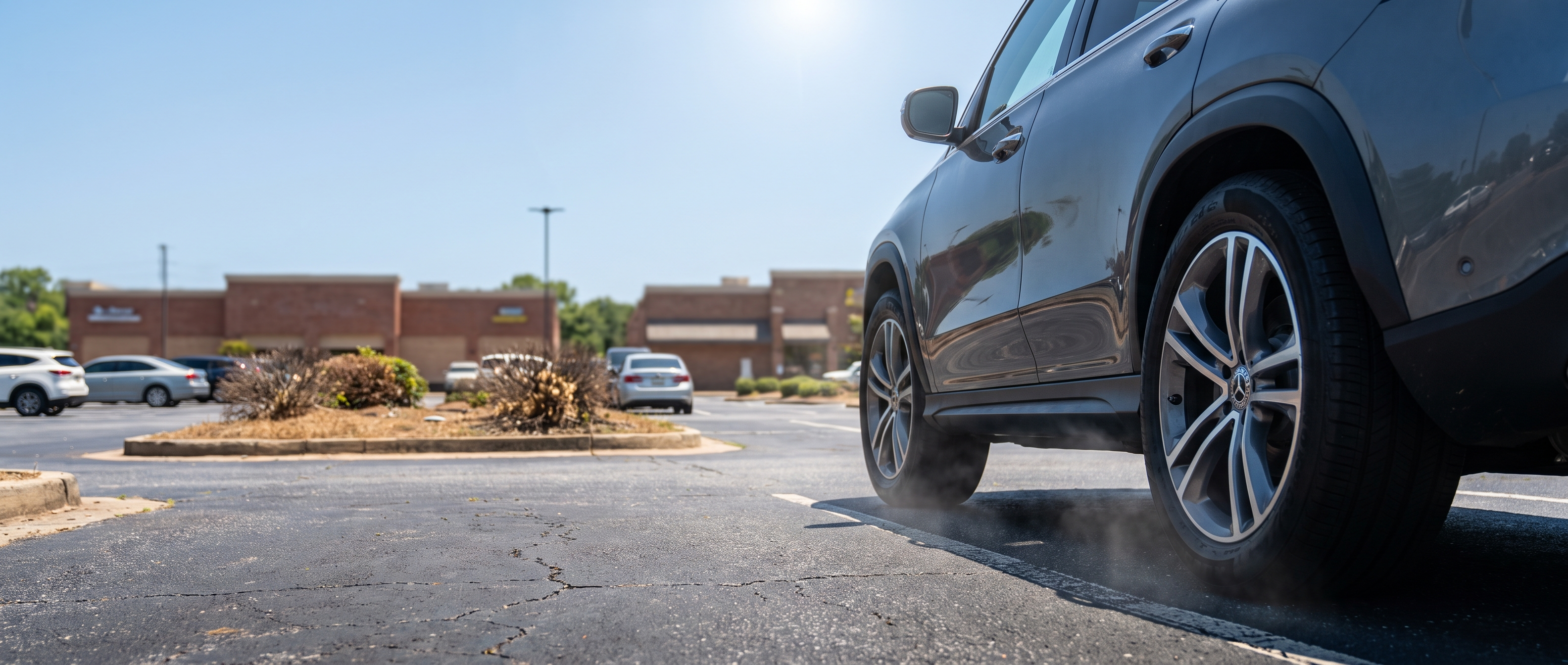
July in Duluth isn't subtle. By the time you climb into your Mercedes-Benz at noon, the outside air is already touching 91 degrees F, and the black asphalt under your tires has spent hours soaking up direct sun, pushing its surface well past 130 degrees F. Between the ambient heat and the radiant heat conducting up through the contact patch, your tires have gained pressure since you last looked at them. Nothing's leaking or broken. It's just physics.
The practical question is straightforward. If your tire pressure reads higher than the door placard specifies, should you bleed air out? Almost always, no, and understanding why protects both your tires and your safety. We see this in the service center every midsummer, owners puzzled by a TPMS indicator that appeared at 7 AM and vanished by 9 AM, or by tires reading 38 PSI when the placard says 35.
The Mercedes-Benz GLE is a useful car to ground this. Its door placard specifies 38 PSI front and rear for the standard 19-inch fitment, and on a July morning that starts at 71 degrees F and climbs to 91 degrees F before your commute is done, that single day's swing is enough to move pressure meaningfully. No mile driven.
Your Mercedes-Benz's recommended tire pressure is always a cold measurement. Heat will raise it. The right response is to check before you drive, not bleed air after.
Schedule a Tire Pressure Check
How Does Heat Actually Change Tire Pressure?
Heat raises tire pressure through Gay-Lussac's Law, a straightforward consequence of the Ideal Gas Law, which says the pressure of a fixed volume of gas rises proportionally with temperature. Your tires are a sealed volume, so heat the air inside and pressure climbs; cool it back down and it drops again.
The practical rule lines up with tire industry guidance. For every 10 degrees F rise in temperature, tire pressure increases by approximately 1 PSI. Atlanta's July is where that rule gets concrete.
| Heat Source | Temperature Impact on Tires | PSI Effect |
|---|---|---|
| Overnight low to July daily high (Atlanta) | +19 degrees F to +20 degrees F ambient swing | +~2 PSI from ambient alone |
| Direct sunlight on a parked tire (vs. shade) | Radiant heat adds significant additional temp to tire surface | +3-5 PSI additional beyond shade reading |
| Driving 20 minutes in stop-and-go traffic (I-85 corridor) | Friction and flexing generate internal heat | +4-5 PSI above cold reading |
| Combined worst-case (parked in sun, then driven) | All three sources stack | Can reach 6-8+ PSI above cold reading |
There's an important distinction. Ambient temperature works on the air inside the tire passively, while driving generates a separate, additional heat source through tire flexing and friction with the road. Then there's a third source almost nobody discusses, and that's asphalt conduction. On a 91 degrees F Atlanta day, the blacktop itself sits roughly 40-60 degrees F hotter than the air. Your tires touch that surface every time you stop, and heat transfers into the lower sidewall and contact patch. None of it's dramatic, though it adds to the stack.
Put those three sources together and you can see why a tire that read perfectly correct at 7 AM can read 4-6 PSI higher by the time you've arrived at Buford Highway for a 10 AM errand.
What Does the Mercedes-Benz TPMS Actually Measure?
Mercedes-Benz vehicles use a direct TPMS system, meaning physical pressure sensors sit inside each wheel and transmit real-time PSI readings to the instrument cluster. The live number is genuinely useful, and it's also the source of some summer confusion, since a real-time reading naturally moves as the air inside the tire heats and cools across the day.
| System Type | How It Works | What It Shows You |
|---|---|---|
| Direct TPMS (Mercedes-Benz) | Pressure sensors inside each wheel transmit live PSI readings | Real-time pressure at the sensor's location (which reflects current air temperature inside the tire) |
| Indirect TPMS | Uses ABS wheel-speed data to infer pressure changes | No PSI number, only a deviation flag |
Because the Mercedes-Benz system reads actual PSI in real time, its readings change through the day as temperatures change, which is by design. The indicator light will illuminate when pressure drops below a threshold (typically around 25% below the recommended cold inflation pressure per NHTSA's federal standard, or earlier on some models), but it doesn't flag overinflation the same way.
The nuance that matters in July goes like this. Suppose your tires are sitting at the low edge of acceptable pressure after an early-morning cold reading, and you then park in direct sun; the radiant and conductive heat will raise the reading on your cluster. The car looks fine at midday. When you park for the evening and temperatures drop overnight back toward 71 degrees F, you're back at that borderline pressure. Morning comes, the TPMS light appears. You add air. The light goes off. By noon, you're reading high again. That cycle isn't a malfunction. On a GLC, an E-Class, or any other model in the lineup, the same physics apply.
The fix is to start from a correct cold reading rather than chasing the symptom midday.
Our service center can verify your cold pressures and reset the TPMS to the correct baseline.
When Is the Right Time to Check Pressure, and What Should You Do?
Check first thing in the morning, before you drive, because that cold-tire window is exactly what the placard is written for, meaning tires that have sat at least three hours or covered fewer than one mile at low speed. Check after a drive, or after the car's been baking in a lot, and you get a warm reading that's artificially elevated and simply not comparable to the spec.
The practical summer protocol for any Mercedes-Benz runs like this.
- Check before 8 AM when possible. In Duluth in July, temperatures climb quickly once the sun clears the tree line. Earlier is better.
- Use the door placard, not the tire sidewall. The number molded into the tire's sidewall is the maximum pressure the tire can handle structurally. It isn't your target. Your target is the placard.
- Do not bleed air from hot tires to hit the placard spec. If your tires read 39 PSI on a 95 degrees F afternoon and the placard says 35 PSI, bleeding them down to 35 PSI hot leaves them at 31-33 PSI cold the next morning. Underinflation is harder on tires than the temporary overinflation heat brings, and underinflated tires in summer heat build internal heat faster, which is the actual blowout risk.
- Reset the TPMS after correcting cold pressure. Access Service in your instrument cluster via the steering wheel controls, navigate to Tire Pressure, and confirm the new baseline. The system then monitors deviations from that reference.
- If the light stays on after a correct cold fill and reset, come in. Persistent illumination after steps 1-4 can point to a sensor battery or a slow leak, both of which need hands-on inspection.
Tire Pressure Terms Worth Knowing
| Term | What It Means |
|---|---|
| Cold inflation pressure | PSI measured before driving, or after 3+ hours parked; this is what your placard specifies |
| Hot inflation pressure | PSI measured after driving; always higher than cold; not comparable to the placard target |
| TPMS (Tire Pressure Monitoring System) | Direct sensor system in each Mercedes-Benz wheel that transmits live PSI readings |
| Door placard | The manufacturer-specified target PSI for your specific vehicle, found on the inside of the driver's door frame |
| Maximum tire pressure | Number molded on the tire sidewall; a structural limit, never a target |
What This Means for Your Mercedes-Benz This July
The Mercedes-Benz TPMS tells you more than a simple warning light ever could, and that's the honest tradeoff, because the same real-time visibility can feel confusing when readings swing 4-6 PSI between your morning commute and the post-lunch check. None of that is a defect, and in normal Atlanta July conditions it won't cause harm as long as your starting pressure is correct. The system is doing exactly what it should.
Where you want to be careful is the pile-up: a tire that came out of winter service marginally low (or a slow nail puncture that hasn't announced itself yet), Atlanta's morning-to-peak July swing amplifying that underinflation, and then 45 minutes of stop-and-go on I-85. Underinflation compounds heat buildup inside the tire. That pile-up is what creates the risk, not the expected expansion from a correctly inflated tire on a hot day.
Our team's recommendation is simple. Schedule a pressure verification and TPMS reset in July, even if the light isn't on. Our service center is in Duluth. Confirming a correct cold baseline costs nothing to check and takes a few minutes, and done right once in summer, it keeps you calibrated straight through August.
Frequently Asked Questions
If my TPMS light comes on in the morning and turns off after driving, does that mean my tires are fine?
Not necessarily. Heat from driving raises tire pressure, which can push a borderline-low tire back into range temporarily. The light appearing consistently in the morning (when tires are cold) and extinguishing after warming up is a reliable signal that your cold pressure is running lower than it should be. Correct the pressure while tires are cold, then reset the TPMS. If the pattern repeats, a slow leak or sensor issue may be present and warrants a service visit.
Should I let air out of my tires when they read higher than the door placard in July heat?
No. That reading is a hot measurement, taken after ambient heat, direct sun, or driving have raised the pressure above the cold baseline. Bleeding air from a hot tire will leave you underinflated the following morning when temperatures drop back to overnight lows. Underinflated tires generate more internal heat when driven, which is the condition that increases blowout risk in summer. Match the placard when tires are cold, and leave the hot reading alone.


