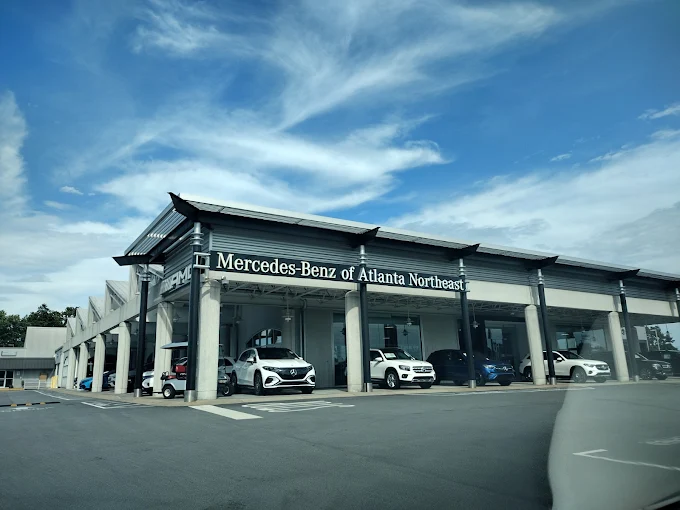


Wet Leaves on Duluth Side Streets: A Mercedes-Benz Tire Safety Guide
Posted at Thu, Nov 5, 2026 7:11 PM
You feel it before you see it. A slight hesitation, a brief shimmy, the steering going a little light. Our service team at Mercedes-Benz of Atlanta Northeast can place that feeling on the calendar, right as the oak and maple leaves come down on Duluth's shaded residential streets and gather in the low spots near Berkeley Lake Road and the neighborhoods tucked off Buford Highway. The bottom line runs like this. Wet leaves act like a lubricant between your tires and the pavement, your safety systems only respond to wheel slip after it's begun, and the one thing that changes how fast the slip starts is tread depth.
That distinction matters more than it sounds, and it's worth your two minutes here.
What's Actually Going On Under Your Tires?
What's happening under your tires is simple physics with an ugly result, since leaves and rain (and in Georgia's first week of November, rain usually follows) combine their natural waxes and cellulose into a low-friction film across the pavement that behaves far more like wet soap than standing water. The symptom feels subtle; the cause is pure mechanics.
| Symptom the Driver Notices | Likely Cause | What to Do |
|---|---|---|
| Brief shimmy or steering lightness on a residential turn | Tire contact patch sliding on wet leaf film | Ease off throttle; do not brake abruptly |
| ESP warning light flickers, then clears | System detected and corrected wheel slip | Normal operation; check tread depth afterward |
| Longer stopping distance than expected at a stop sign | Tread grooves unable to channel leaf film away from contact patch | Inspect tread depth; consider service appointment |
| Rear steps out slightly on acceleration from a light | Rear drive wheels spinning on leaf-covered pavement | Reduce throttle; have tread checked |
When water mixes with the natural waxes in leaves, it creates a film that dramatically reduces tire grip. That film sits under the tire instead of getting displaced, and it won't clear on its own. A wet, leaf-covered road should be treated as a reduced-traction surface even when it looks dry at a glance. The leaves can hold moisture long after the rain has stopped, so the hazard outlasts the weather that caused it.
None of this shows up as drama. It shows up as a car that's a half-beat slow to answer.
The Role of ESP and ABS: Real Help, Real Limits
ESP gives you genuine help with genuine limits, and both halves of that matter, because Mercedes-Benz co-developed the Electronic Stability Program in partnership with Bosch, launched it in 1995, and built it to monitor the vehicle's speed, steering angle, and yaw rate (the rate at which the vehicle is rotating around its vertical axis). When the system detects that a wheel is spinning faster than it should be for the given steering input, it intervenes before you've fully registered the slip. If the system detects that the vehicle is beginning to skid or slide, ESP kicks in automatically, reducing engine power and applying brake pressure to individual wheels to help bring the vehicle back in line with the driver's intended path.
That is genuinely useful. Here's where we level with you, though.
ESP and ABS respond to slip that's already occurring. They don't prevent the initial loss of contact. Tire tread depth and inflation are critical in poor conditions; good tread channels water away, while proper air pressure ensures maximum road contact. On a leaf-film surface, the gap between a tire at 7/32" of tread and one at 2/32" is the gap between grooves that cut through the film to find pavement and a tread that simply rides on top of it. ESP handles the correction, and tread depth handles the prevention.
The honest tradeoff: Mercedes-Benz vehicles carry some of the most sophisticated active-safety systems available. That capability is real. What it cannot do is compensate for a contact patch that has lost its mechanical grip. The system buys you recovery time; tread depth buys you grip in the first place.
A GLC taking a neighborhood turn off Buford Highway on fresh tires handles that leaf-film on its contact patch very differently than the same vehicle on tires at the legal minimum. The electronics are identical. The grip isn't.
Why November 2026 Is the Moment to Check
Timing matters here for the Atlanta metro, because according to the Georgia Forestry Commission's latest Leaf Watch report, radiant fall colors are continuing to develop across north Georgia, with an estimated 87% of foliage above 3,000 feet having changed color. Up here it's not an abstract statistic once it's your own street under the canopy.
The season's gotten off to a slower start than recent years, with color development running about a week behind, and Georgia Forestry Commission officials expect peak fall foliage during the latter half of the first week of November. For Duluth specifically, closer to Atlanta, peak leaf change typically arrives in the first week of November, which is exactly the window we're in right now.
What that means is leaf drop sits at its peak on the streets you drive every day. Think of the shaded residential corridors near the Chattahoochee River National Recreation Area, and the gentle S-curves on neighborhood roads that cut between subdivisions. These are the places where leaves accumulate fastest and dry out slowest, because direct sunlight never reaches them. Those are also the places where your tires matter most, and that's not a coincidence.
The critical tread depth threshold for wet-surface driving is 4/32 of an inch, not the legal minimum of 2/32. Below 4/32, the grooves lose the volume needed to channel water and leaf film away from the contact patch efficiently.
The federal government sets the legal minimum tread depth for passenger tires at 2/32-inch, the point where grip, handling, and wet stopping distance are believed to become severely compromised. But the safety case isn't really about that number; it's about what happens well before it. Most tire safety guidance requires at least 4/32" of tread depth for safe wet-weather driving; when tread becomes shallower than this threshold, the grooves lose their ability to channel water, causing the tire to ride on top of the water rather than maintaining contact with the road surface.
Next step: If you haven't had a tread depth check in the last six months, now (before the heaviest leaf-drop weeks) is the right time to schedule one.
DIY Checks vs Letting the Service Team Handle It
Some of this you can handle in your own driveway, and some of it belongs on a lift with a calibrated gauge, so it's worth splitting the work cleanly between what a quick home check will catch and what a trained eye needs to confirm for you.
What you can check yourself:
- The quarter test. Insert a U.S. quarter into the tread groove, Washington's head pointing down. If the top of his head is visible, you're at or below 4/32". That's the threshold to act on.
- Tire pressure. Your Mercedes-Benz TPMS monitors pressure continuously, but cold mornings in November can drop tire pressure by roughly 1 PSI for every 10-degree Fahrenheit drop in temperature. Check the TPMS readout on your instrument cluster when the tires are cold, since that's the number you want.
- Visual sidewall check. Look for cracking, bulging, or any visible deformation along the sidewall. A bulge isn't a cosmetic issue.
What belongs in the service center:
- Tread depth gauge measurement. The quarter test tells you whether you're in the warning zone. A calibrated depth gauge tells you exactly where you are across all four tires and in multiple grooves per tire (edge wear from alignment issues often shows up in a single groove, not all of them).
- Alignment check. Uneven leaf-related braking loads can reveal an alignment drift you wouldn't notice in normal dry conditions. Misalignment causes uneven tread wear that the TPMS can't detect.
- Tire approval verification. Mercedes-Benz vehicles are engineered to specific tire specifications. The GLE and the S-Class run very different tire specs, and a replacement tire that doesn't meet the vehicle's speed rating and load index can undermine the precision of the ESP system that works so hard on your behalf.
Our team checks tread depth across all four tires with a calibrated gauge, verifies inflation against the vehicle's door-placard spec, and flags any sidewall or wear-pattern issues that a visual scan might miss. We'll also confirm that any tires already on the vehicle carry the appropriate approval for your specific model.
Frequently Asked Questions
Does ESP protect me on wet leaves the same way it does on wet pavement?
ESP operates on the same principle regardless of the surface: it detects wheel slip via yaw-rate and wheel-speed sensors, then modulates brake pressure and engine output to bring the vehicle back to the driver's intended line. On wet leaves, though, the available friction is lower than on wet pavement, so the system has less traction to work with when correcting. It still intervenes. It just has less to work with. Adequate tread depth (4/32" or more) gives the system a better foundation by reducing how much slip occurs before the correction begins.
How do I know if my tires are worn enough to be a real concern on Duluth's leaf-covered streets?
The quarter test is a reliable starting point: insert a U.S. quarter into the tread groove with Washington's head facing down and toward the tire. If the top of his head is visible, you're at or below approximately 4/32" and wet-surface performance has begun to degrade. For a precise reading, a tread depth gauge measured across multiple grooves on each tire tells you exactly where you stand. Our service team performs that measurement as part of a standard tire inspection, and we'll walk you through the findings for each tire individually.


