

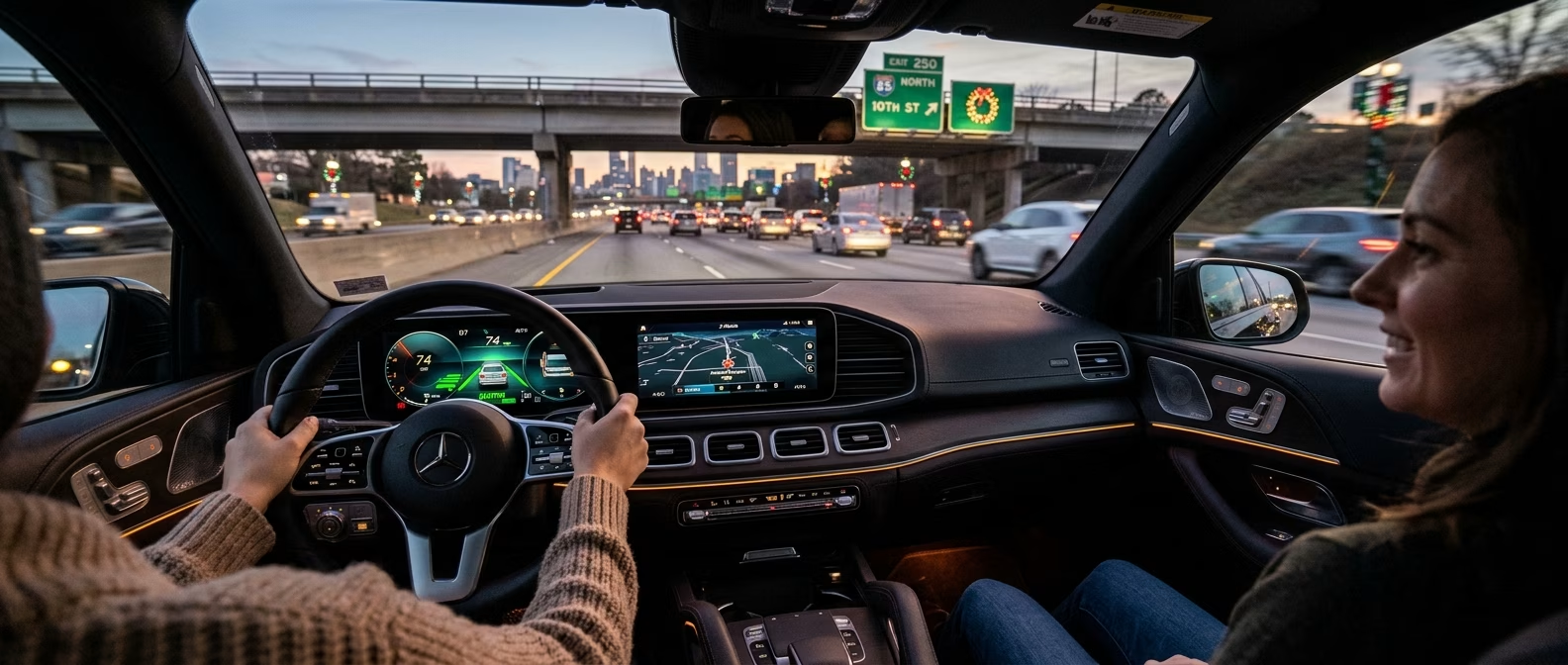
Using Mercedes-Benz Driver Assistance on Long Holiday Drives | Atlanta
Posted at Wed, Nov 18, 2026 5:44 PM
The Thanksgiving I-85 crawl out of Duluth tightens the shoulders of even seasoned Atlanta-area commuters. You get miles of brakelights, lane changers cutting in without warning, and a GA-400 mountain run to Dahlonega waiting on the far side. If your Mercedes-Benz carries the Driver Assistance Package, you're holding a genuinely powerful toolkit for exactly this kind of drive. What people ask us about isn't what the systems do. The real question is how to use them together, in the right sequence, across a real six-hour holiday trip.
So, the plain version. These systems don't drive for you, and one of them (ATTENTION ASSIST) resets every time you open the door, which matters if you're planning three short gas station stops. Used correctly, though, DISTRONIC, Active Steering Assist, Route-Based Speed Adaptation, and PRE-SAFE form a layered suite that takes measurable load off a tired driver. We'll walk you through each layer, model by model, so you know what to reach for and when.
The short version
- DISTRONIC (Active Distance Assist) maintains your chosen following gap and handles full stop-and-go in equipped models. It's the workhorse of the holiday drive.
- Active Steering Assist keeps you centered through long highway curves. On GA-400 heading toward Dahlonega, it has a real job to do.
- ATTENTION ASSIST monitors over 70 steering and behavior parameters and suggests a break when it detects fatigue. It operates between 37 mph and 124 mph and resets when you open the driver's door.
- Route-Based Speed Adaptation (Driver Assistance Package) proactively slows the vehicle for mapped curves, highway interchanges, and toll plazas before you brake.
- PRE-SAFE is standard on the 2026 GLE across all trims. It's always on, always watching.
- Which features you have depends on whether your vehicle includes the Driver Assistance Package. The table below shows what each tier delivers.
The 2026 Mercedes-Benz GLE is the most popular vehicle in our Duluth showroom for the Atlanta-area family trip, and it's the reference model throughout this guide. Many of these systems also appear on the E-Class and The S-Class, with the S-Class carrying the most capable configuration of all.
Which Driver Assistance Features Does My Mercedes-Benz Actually Have?
Your exact feature set comes down to two things: the model, and whether the Driver Assistance Package was included or optioned onto the car. Getting this wrong before a long drive is where disappointment usually starts. A driver engages what they assume is DISTRONIC, finds it's the standard adaptive cruise (which doesn't handle full stops), then manages the last mile of holiday traffic by hand.
Here's what each tier delivers on the 2026 GLE, verified against Mercedes-Benz's published specifications:
| Feature | Standard (All 2026 GLE Trims) | With Driver Assistance Package |
|---|---|---|
| Active Distance Assist DISTRONIC | Not standard (GLE 350) | Yes, full stop-and-go |
| Active Steering Assist | No | Yes, centered in lane through curves |
| Route-Based Speed Adaptation | No | Yes, uses map data for curves and interchanges |
| Active Lane Change Assist | No | Yes, automatic lane change on signal |
| Active Speed Limit Assist | No | Yes, reads posted limit, adjusts cruise speed |
| Evasive Steering Assist | No | Yes |
| ATTENTION ASSIST | Yes, standard | Yes, standard |
| PRE-SAFE | Yes, standard | Yes, standard |
| Active Brake Assist | Yes, standard | Enhanced with Turning and Cross-Traffic function |
| Blind Spot Assist with Exit Warning | Yes, standard | Active Blind Spot Assist (adds corrective braking) |
A word of candor here. The Driver Assistance Package is where the holiday-drive capability lives. Standard features handle warnings and emergency intervention well, and the package is what adds the sustained, semi-active assistance that pulls fatigue down over six hours. If your GLE doesn't include it, the core DISTRONIC, Active Steering Assist, and Route-Based Speed Adaptation aren't available. Worth confirming in your MBUX settings or owner's portal before you leave Tuesday evening.
When and How to Use Each System on a Real Holiday Drive
Think of the holiday drive as three distinct phases, because each one asks a different set of tools to do the heavy lifting. The congested exit, the curving climb, and the long open highway all stress the car in different ways. Match the system to the phase, and the trip gets quieter.
Phase 1: The I-85 Corridor Out of Duluth (Stop-and-Go)
DISTRONIC earns its place right here. I-85 northbound and southbound through Duluth is stop-and-go holiday traffic at its most relentless. The system uses forward-facing radar sensors to maintain a driver-selected following distance, managing full stops and smooth resumption without you touching the accelerator or brake. Set your following distance to the widest setting (level 5) in heavy conditions. At the wider gap the system has more time to calculate deceleration, so it slows, stops, and resumes more smoothly.
One thing to know. When a vehicle cuts into your lane at close range, DISTRONIC brakes more assertively than it does during a gradual slowdown. That response is intentional and correct, even though it can feel abrupt the first time. We tell drivers to expect it rather than read it as a system error.
On the 2026 GLE with the Driver Assistance Package, Active Steering Assist works alongside DISTRONIC in stop-and-go traffic, helping center the vehicle in the lane even when lane markings are unclear or temporarily obscured by concrete barriers.
Phase 2: GA-400 to Dahlonega (Curves and Elevation Change)
GA-400 north of Atlanta rolls through gentle terrain before it starts to climb, and that's where Route-Based Speed Adaptation and Active Steering Assist do something a standard adaptive cruise cannot. The system reads live map data and trims speed before a curve or interchange rather than reacting once the curve has already begun. Active Steering Assist tracks lane markings and guardrails at the same time, feeding gentle steering support through the arc.
Now the honest limitation. Active Steering Assist doesn't hold the wheel for you, and it isn't built for tight switchbacks. On the gentler highway curves of GA-400 it performs well. On the narrow mountain roads approaching Brasstown Bald or the Russell-Brasstown Scenic Byway, the system will disengage (and tell you so with a steering-wheel prompt) and hand full steering back to you. That's the system working as designed, so don't read the disengagement as a failure.
Team observation: A pattern worth naming on winding roads is the driver who runs DISTRONIC through the twisty sections and then describes the system as "fighting" them. What's actually happening is Active Steering Assist making micro-corrections to keep the vehicle centered while the driver counter-corrects against it. Keep a light grip. Let the system do the centering. Steer hard against it and the system reads that as a takeover request and steps back.
Phase 3: Open Highway and Fatigue Management (Hours 3 Through 6)
ATTENTION ASSIST gets its moment here, and it works quietly in the background. The system spends the first few minutes of any drive analyzing your personal steering patterns across more than 70 parameters, building your baseline. After roughly 30 minutes of continuous driving, it starts comparing your current inputs against that baseline. When the corrections drift in ways consistent with fatigue, the instrument cluster shows a coffee cup symbol and an audible alert prompts a break.
It operates between 37 mph and 124 mph. One detail does the real work here: ATTENTION ASSIST resets its drowsiness assessment when you unfasten your seatbelt and open the driver's door. A quick gas station stop where you stay in the car doesn't reset the clock. Getting out and walking around does. If you're driving I-75 south toward Florida for Thanksgiving, plan your stop accordingly.
What the 2026 GLE Delivers Standard (Before You Buy Any Package)
Let's be direct about this, because the marketing language can blur it. Even without the Driver Assistance Package, every 2026 GLE arrives with a meaningful baseline. PRE-SAFE is standard across all six trim levels. When the system detects an imminent collision, it tightens the front seat belts, closes the sunroof and windows, and emits a "pink noise" tone that triggers a natural reflex in the ear to prepare for impact. None of that is adaptive cruise. It's collision preparation, and it's always working.
Standard ATTENTION ASSIST and Active Brake Assist with cross-traffic warning come on every trim as well. The 2026 GLE 350 adds Blind Spot Assist with Exit Warning Assist, which warns occupants before they open a door into passing traffic, plus the rearview camera and PARKTRONIC system. Genuinely useful features, all of them. They simply aren't the same as the sustained, active highway assistance the Driver Assistance Package provides.
The GLS and S-Class sit above the GLE on driver assistance depth, and the S-Class carries the most comprehensive suite in the lineup by a wide margin. If you're making an Atlanta-to-Savannah run twice a year, the gap in sustained-cruise capability is worth experiencing before you decide.
Which System Level Fits Which Holiday Driver?
| Driver Profile | Best System Match | Why It Fits |
|---|---|---|
| Duluth-to-Savannah family run, 4+ hours | Full Driver Assistance Package on GLE or E-Class | DISTRONIC + Route-Based Speed Adaptation handle the sustained highway load; ATTENTION ASSIST monitors the fatigue curve |
| Mountain weekend run up GA-400 | Driver Assistance Package + light hands on wheel | Active Steering Assist handles the highway curves; know it disengages on tight mountain roads |
| Short I-285 holiday errand runs | Standard PRE-SAFE + Active Brake Assist | Stop-and-go at low speed doesn't need the full package; standard braking and collision prep cover it |
| Multi-day I-95 corridor trip | S-Class or GLE with full package | The longest drives need the deepest system; Route-Based Adaptation and ATTENTION ASSIST together are worth it |
| Occasional highway commuter, light tech user | ATTENTION ASSIST standard is enough | The fatigue monitor requires nothing from you; the DISTRONIC question becomes "how often do I actually use it?" |
What's Coming Next in Mercedes-Benz Driver Assistance
Knowing where this technology is heading matters, because it shapes what you spec today. Mercedes-Benz announced in November 2026 that it's launching an Early Access Program in December 2026 for select California owners of properly equipped vehicles. The program introduces Hands-Free Highway Assist (working alongside DISTRONIC at speeds up to 85 mph on eligible mapped highways) and Proactive Lane Change Assist, which can initiate and complete lane changes automatically to follow a navigation route. Nationwide availability is expected in spring 2027, with delivery via over-the-air update on vehicles equipped with the necessary sensor hardware.
The underlying sensor suite on current eligible models already includes ten cameras, five radar sensors, and twelve ultrasonic sensors, so the hardware is there. The software is what's arriving. If you're configuring a 2026 GLE or GLC today with long-term ownership in mind, whether that vehicle carries the compatible sensor package is worth confirming with our team before you finalize the order.
Frequently Asked Questions
Does DISTRONIC work in complete stop-and-go traffic, or just highway speeds?
On 2026 Mercedes-Benz models equipped with the Driver Assistance Package, Active Distance Assist DISTRONIC handles full stop-and-go, including bringing the vehicle to a complete stop and resuming when traffic ahead moves. On vehicles where DISTRONIC is a stand-alone option without the full package (such as the 2026 C 300), the capability may vary. Standard adaptive cruise without the package does not handle full stops on all models. Confirm your specific vehicle's configuration in the MBUX vehicle settings menu before a long drive.
Does ATTENTION ASSIST really reset when I stop the car?
Yes, and this matters for holiday trip planning. Mercedes-Benz confirms that ATTENTION ASSIST resets its drowsiness assessment when you unfasten your seatbelt and open the driver's door. A drive-through stop where you stay behind the wheel does not reset the baseline. Getting out at a rest stop does. For drives longer than four hours, we advise planning one real stop where you exit the vehicle, rather than multiple drive-through pauses. The system needs a genuine reset to give you an accurate new drowsiness baseline.
Will the lane assistance fight me when I try to change lanes intentionally?
No. Active Steering Assist is designed to recognize deliberate steering inputs and step back when you actively steer against its corrections. It reads purposeful steering as a driver takeover request. The system also deactivates automatically when you activate the turn signal for an intentional lane change. Where some drivers feel the "fighting" sensation is on winding roads, when the system is making small centering corrections at the same moment the driver is also adjusting. The fix is simple: keep a light, relaxed grip and let the steering wheel move naturally. Gripping tightly and counter-correcting creates the conflict.


