

October Safety Checklist: Lights, Tires, and Brakes for Duluth Mercedes-Benz Owners
Posted at Wed, Oct 14, 2026 10:46 AM
October is the month your Mercedes-Benz quietly stops tolerating neglect around here. Overnight lows averaged 53 degrees this year, and afternoon highs still push into the low-to-mid 70s, which is the kind of swing that drops tire pressure, surfaces brake wear that summer's shorter stops kept hidden, and puts Georgia's headlight law in play on every rainy afternoon out on I-85. We cover those three systems below. Work through them now, before the cold sets in, and you'll roll into November with nothing hanging over you.
What Goes on the October Checklist?
Three items earn a spot on the October list, and each one is time-sensitive to this exact point in the calendar rather than some vague someday, because the cooling nights and wet afternoons work directly on your tires, your brakes, and your lights in ways you can actually catch now.
- [ ] Tires. Check cold pressure against the door-placard spec. Inspect tread depth at all four corners. Look for sidewall cracking, uneven wear, or any bulging.
- [ ] Brakes. Look through the wheel spokes at pad thickness. Listen for squealing or grinding. Note whether the brake pad wear message has appeared on the instrument cluster.
- [ ] Lights. Walk the vehicle with the headlights, taillights, brake lights, and turn signals all active. Verify the interior lamp that confirms each bulb is functioning.
Call it thirty minutes on a weekend morning, ideally before you've driven anywhere (cold tires give you a true pressure reading). The sections below walk through the mechanics behind each item, so you understand what each one is actually telling you.
Why These Three Items Matter Right Now
Tires: The TPMS Light That Wasn't There Last Week
Tire pressure drops roughly 1 PSI for every 10-degree Fahrenheit decrease in ambient temperature, and Duluth's October mornings regularly run 20 to 25 degrees cooler than the afternoons that followed our late-summer driving, which is exactly why a tire you set correctly in August can read low by the time you back out of the driveway in October. If those tires went to spec in 90-degree August heat, they may already be 2 to 3 PSI down before you've gone anywhere. The TPMS on your Mercedes-Benz illuminates when pressure falls 25 percent below the recommended spec, so you can sit meaningfully soft and still see no warning at all. On our Duluth service drive, the first cool snap is when these soft readings start showing, usually before the dash says a word.
Don't wait for the warning light to make the call. Set them cold and move on.
Check the door-placard sticker (driver's side door jamb, not the sidewall) for your specific PSI spec. Most Mercedes-Benz passenger vehicles call for 32 to 35 PSI, though the GLE, GLS, and S-Class can run higher. Check tires cold, meaning the car has been parked at least three hours. Driving heats the air inside and inflates what you'll read on the gauge.
Tread is the next number to watch. U.S. law sets the minimum at 2/32 of an inch, the point where the wear indicators sit flush with the surface. We think that's cutting it too fine. Performance tires start losing meaningful wet-weather grip well before 2/32", and our October rain on I-85 shows up without much notice. At 4/32", plan for replacement. At 2/32", stop driving on them.
On AWD models like the GLE 4MATIC or E-Class 4MATIC, all four tires should be within 2/32" of each other in depth. A mismatched set throws off the torque-distribution readings the vehicle's on-board systems rely on. It matters more than you'd guess.
Note on age: Rubber compounds harden over time no matter how much tread is left. Tires beyond six years of age warrant a close look even if the depth gauge says you're fine. Check the DOT date code on the sidewall (the last four digits are the week and year of manufacture).
Brakes: What Summer's Short Stops Hid From You
Mercedes-Benz electronic wear sensors trigger a dashboard warning when pad friction material reaches approximately 3mm, but front brakes do roughly 70 percent of the braking work and wear 2 to 3 times faster than the rears.
Stop-and-go on I-285 northbound between 4:30 and 6:30 PM, five days a week, never builds the sustained, high-temperature brake events that a mountain descent on GA-400 toward Dahlonega does. So the wear doesn't announce itself. If you ran up to the Blue Ridge area this summer and felt any pedal pulse or heard a squeal on the way back down, that was the system talking to you.
What to look for through the wheel spokes:
| Item | What You're Measuring | Action Threshold |
|---|---|---|
| Pad friction material | Remaining thickness | Replace at or below 3mm (approx. thickness of two stacked pennies) |
| Rotor surface | Scoring, deep grooves, heat spots | Consult service center if grooves are visible or surface is ridged |
| Rotor edge lip | Lip height vs. rotor face | A raised lip indicates wear; measurement against minimum spec required |
| Wear pattern | Inner vs. outer pad evenness | Uneven wear can indicate a seized caliper |
The brake pad wear sensor on a Mercedes-Benz sits on the front-left and rear-right wheels, and it trips the dashboard warning when those two pads reach their limit. It says nothing about the other two corners. A passing warning-light check still leaves half the car unchecked, so a clean dash doesn't mean a clean system.
Grinding is past the conversation stage. If you hear metal-on-metal contact under braking, book the appointment today. Rotors you've already ground into aren't a polish-and-go situation.
Schedule a Fall Brake and Tire Inspection
Lights: Georgia Law Has an October Clause You Should Know
Georgia treats headlight compliance as more than a sunset-to-sunrise rule, and that's the part worth knowing this month, since Georgia Code section 40-8-20 adds two more triggers on top of darkness, meaning any time it's raining and any time visibility drops under 500 feet for any reason you're required to have them on. In practice, every October afternoon rainstorm on I-85 or Buford Highway requires headlights on. Not running lights. Headlights.
The catch is that automatic headlights don't always follow the law. Georgia courts have noted that auto-headlight systems respond only to ambient light levels, and rain or wiper activation won't always trip them. A car in a well-lit downtown area, or on a highway with decent streetlighting, may not trip the auto-sensor even in rain. The law applies no matter whether your car's system wakes up on its own.
Walk your vehicle with someone else operating the controls and confirm:
- Both low-beam headlights are functioning and aimed correctly (one burned-out headlight is a traffic stop)
- Both taillights illuminate with the headlight switch
- Brake lights activate at all three positions (rear left, rear right, and the center high-mount)
- All four turn signals cycle properly
- Hazard lights work front and rear
One area worth attention on higher-mileage Mercedes-Benz vehicles is the center high-mount stop lamp. The high-mount lamp is easy to overlook, and it sits directly in the line of sight of whoever's behind you on the Perimeter.
Print-and-Go Recap
Run the entire list before November hits, and plan on about fifteen to thirty minutes with the car cold in the driveway, enough time to clear tires, brakes, and lights in one sitting without a single tool you don't already own.
Tires
- [ ] Check cold pressure against door-placard spec (not sidewall)
- [ ] Penny/quarter test or depth gauge. Replace plan at 4/32", replace immediately at 2/32"
- [ ] Look for sidewall cracking, bulging, or uneven tread wear
- [ ] On 4MATIC models, all four tires should be within 2/32" of each other
- [ ] Check DOT date code. Note any tire over six years old
Brakes
- [ ] Look through wheel spokes at pad thickness (below 3mm = service time)
- [ ] Check all four corners, not just the two with wear sensors
- [ ] Note any squealing, grinding, pedal pulsing, or vibration
- [ ] Dashboard brake-pad warning = do not wait
Lights
- [ ] Headlights (both)
- [ ] Taillights (both)
- [ ] Brake lights (left, right, center high-mount)
- [ ] Turn signals (all four corners)
- [ ] Confirm auto-headlights do not substitute for manual activation in rain
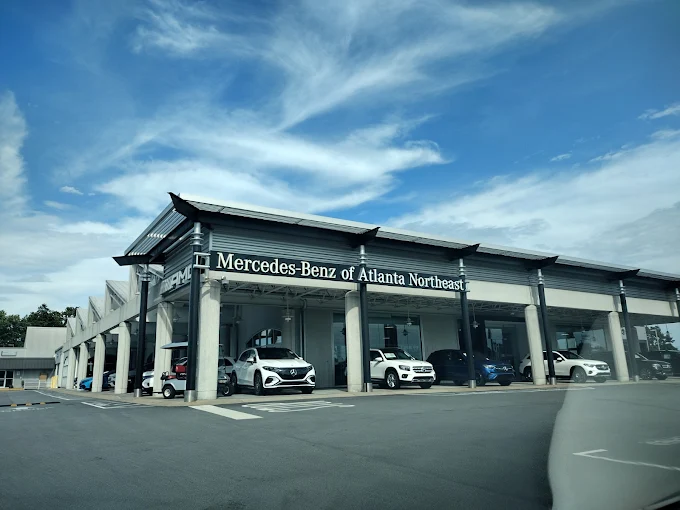
If anything on this list gets flagged, bring it to us at Mercedes-Benz of Atlanta Northeast. Our service center is on Boggs Road in Duluth. Scheduling is straightforward online, and our team can handle tires, brakes, and a full lighting check in a single visit. Call us at 770-691-2339 if you'd rather talk to someone directly.
So is a full inspection worth the time? Most of the time, yes, even though your systems turn out fine and you've spent an hour confirming it. A brake and tire check costs you a morning you could've spent elsewhere, and on most Octobers it ends in a clean bill of health. The one October you skip it tends to be the week something isn't fine, and that's the scenario this checklist exists to prevent. We'd rather you spend an hour confirming a clean bill of health than need us in a hurry come November.
FAQ:
Does the TPMS light mean my Mercedes-Benz tires are flat?
Not necessarily. The TPMS warning activates when tire pressure falls 25 percent below the recommended spec for your vehicle. In October, that can happen on its own, because Duluth's overnight temperatures have dropped a good bit since summer. Check your cold pressure against the door-placard spec (not the sidewall figure) before you call it a puncture. If all four tires are uniformly low by 2 to 3 PSI, the cause is almost certainly the temperature change. Add air to the placard spec, drive briefly, and reset the TPMS through the instrument cluster menu. If one tire sits well below the others, that's worth a closer look.
How do I know if my Mercedes-Benz brake pads really need replacement or if it's just the warning light?
The dashboard brake pad warning is a real signal. It means the electronic wear sensor on at least one axle has contacted the rotor, telling you the pad has reached approximately 3mm. That marks the action threshold, not a suggestion. What the warning doesn't cover is the condition of the pads on the other two wheels. The sensors only sit on two of the four corners. If the warning is on, bring the vehicle in. If the warning is off but you hear squealing under light braking or feel the pedal pulsing, those are physical signs of wear the electronic system hasn't caught yet. Both situations are service appointments, plain and simple.


