
Mercedes-Benz Year-End Service: What to Do Before December in Duluth
Posted at Thu, Nov 26, 2026 9:56 PM
The calendar reads late November, but your Mercedes-Benz might be running on a service clock that quit mattering back in October. ASSYST Plus, the Flexible Service System built into every modern Mercedes-Benz, watches time and mileage at once. If you don't rack up many miles in a year, the one-year time trigger lands well before the odometer trips anything urgent. That's the gap that walks people into December with overdue brake fluid and a cabin filter choked from a full season of Georgia pollen. Our service center can get you in before the holidays.
What Does It Usually Mean When a Mercedes-Benz Shows No Service Alert Before Year-End?
A blank cluster with no wrench symbol doesn't actually mean you're in the clear, because ASSYST Plus resets its counter the moment a service wraps and then counts forward on both time and accumulated driving stress, so a quiet dash can still sit on top of an interval that came due weeks ago. A vehicle driven mostly on shorter urban trips (the I-85 corridor into Buckhead and back, say) logs engine load and partial warm-up cycles, and the system weights those differently than a steady highway mile. Under 10,000 miles on the current interval but past the 12-month mark? Service A is due whether the alert's posted or not.
How Urgent Are Year-End Service Items on a Mercedes-Benz?
Some of these year-end items are genuinely time-critical and others are more about convenience and comfort, so the sorting matters before you book anything, and the honest starting point is brake fluid, which carries a strict calendar rule no matter how much you've driven.
Engine oil on a low-mileage vehicle runs the same degradation chemistry as one with heavy miles. Oxidation and moisture contamination happen with time, not just friction.
Can You Check These Year-End Items Yourself, or Does It Need the Service Team?
A few of these are genuinely owner-accessible, and you can sort them out in the driveway without any tools: tire pressure, a visual wipe-down of wiper blade condition, and reading the ASSYST Plus display through the instrument cluster menu. Pull up the Service submenu on the steering wheel controls and you'll see the remaining days or miles until your next service interval. Anything past that read (the actual fluid conditions, brake pad measurement, battery cold-cranking capacity) needs proper diagnostic tools to assess accurately. There's no shortcut around it.
What Happens When You Bring Your Mercedes-Benz in for Year-End Service?
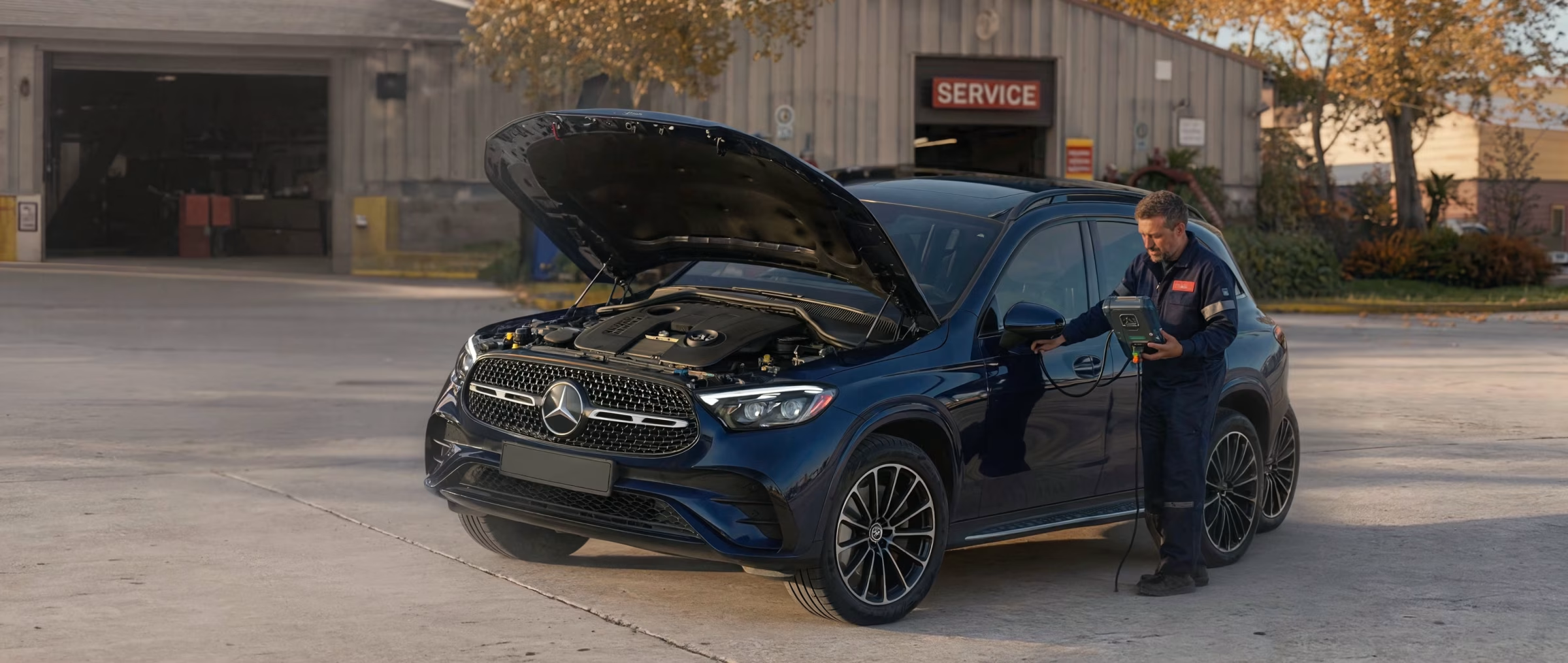
We work through each system in a set sequence rather than a random poke-around, and the visit starts by pulling the ASSYST Plus workshop code, which tells our team exactly which service letter is due along with any subcodes attached to it. Those subcodes flag model-specific catch-up items, like a spark plug interval or a transmission fluid check that only surfaces at higher mileage milestones. A GLC running a 2.0-liter turbocharged engine, for example, might show a different subcode package than a E-Class on the same calendar interval, because the service sheet is model-specific.
Does Atlanta-Area Driving in Late November Make Year-End Service More Important for Mercedes-Benz Owners?
Duluth's November overnight lows average around 43 degrees Fahrenheit, with December nights regularly sliding to 39 degrees, and while that range isn't severe, it's cold enough to push a marginal 12V battery into failure territory on a morning start. This matters especially in Mercedes-Benz vehicles equipped with ECO Start-Stop, where the auxiliary battery handles repeated high-current cycles every time the engine restarts at a light.
A summer of I-85 and I-285 stop-and-go commuting runs a Start-Stop battery through thousands of those cycles before the air cools down. By November, a battery that tested fine in July may not hold a charge reliably once morning temps dip.
How Do You Keep Year-End Service Items From Coming Back on Your Mercedes-Benz?
The simplest pattern is to treat the annual service as a fixed calendar appointment rather than a reactive scramble, because brake fluid follows a strict two-year interval and the cabin filter runs on roughly the same schedule, so keeping Service A and Service B on a predictable cadence cycles those parts out before they turn into a performance issue instead of after.
Frequently Asked Questions About Mercedes-Benz Year-End Service in Duluth
Does the ASSYST Plus system on my Mercedes-Benz tell me everything that's due at year-end?
ASSYST Plus tracks both mileage and time to calculate your next Service A or Service B interval, and it shows a countdown in days and miles in the instrument cluster. What it won't flag is a calendar-only item like brake fluid, which follows a strict two-year replacement schedule regardless of miles driven or what the display shows. If your last Service B was two or more years ago, the brake fluid's due even if the system hasn't posted a wrench icon.
How does the I-285 and I-85 stop-and-go commute affect my Mercedes-Benz service timing in Duluth?
Short urban trips and stop-and-go driving produce more frequent engine warm-up and cool-down cycles, and that introduces more moisture into the engine oil over time. ASSYST Plus accounts for it by weighting driving load in its calculation, so a Duluth commuter who sticks mostly to surface streets and metro Atlanta corridors can reach a service interval faster by the system's math than the raw mileage alone would suggest.
Is the cabin filter replacement really necessary every two years for a Mercedes-Benz in the Atlanta area?
It matters more here than in most markets. The Atlanta metro's heavy pollen season runs from roughly March through April and coats vehicles in a noticeable yellow film. A cabin dust and combination filter that's absorbed a full Georgia pollen season plus summer humidity works harder than the same filter in a drier climate. Service B includes the cabin filter replacement at the 20,000-mile or two-year interval, whichever comes first.
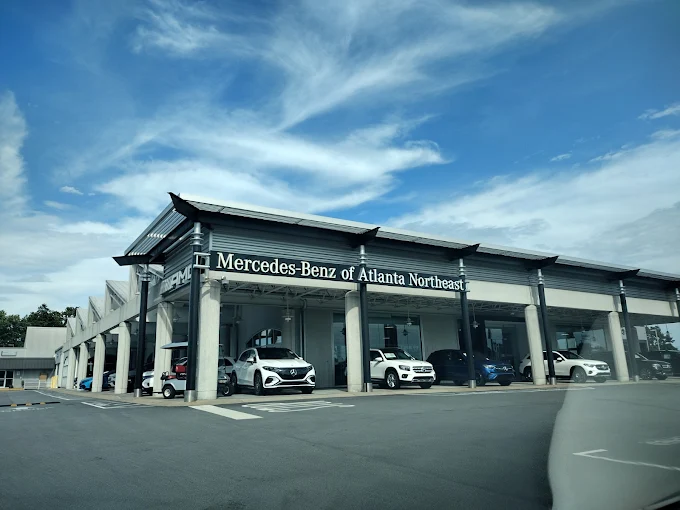
Can I bring my GLC or GLE in for year-end service at Mercedes-Benz of Atlanta Northeast before December?
Yes. We encourage scheduling before mid-December, when the service center calendar fills quickly with owners who've put it off from earlier in the fall. The service appointment page on our site shows current availability, and most Service A and standard Service B visits wrap the same day. Learn more about the GLE model here.
Does year-end service for an all-electric Mercedes-Benz EQ model include different items?
It does. All-electric Mercedes-Benz vehicles have no engine oil to change, so the visit centers on the cabin dust and activated charcoal filter, brake fluid (the two-year calendar rule still applies), tire inspection and pressure, and a check of the high-voltage system. Our inventory includes both EQ and combustion models, and our service team handles both on the same schedule system.


