

Summer Heat and Your Mercedes-Benz: How to Drive Through It Safely
Posted at Tue, Jul 7, 2026 1:32 AM
The National Weather Service issued a heat advisory for metro Atlanta in late June 2026, warning that heat index values would reach 105 to 110 degrees across the area. That sustained combination of heat and humidity places a dual load on your Mercedes-Benz cooling and climate systems simultaneously, stressing components that idle through a mild spring without complaint. July is not the time to postpone a service reminder -- it is the reason one appeared.
A GLE making weekend runs to Lake Lanier or logging morning miles on I-85 through Duluth is operating in exactly the conditions that accelerate wear. Preventive maintenance now is the difference between a smooth summer and a roadside call.
What Summer Conditions Do to Your Mercedes-Benz
Atlanta's July climate is not merely hot -- it is hot and humid at the same time. When ambient temperatures approach 90 degrees with humidity above 75 percent, your A/C compressor does not simply cool the air; it must actively remove moisture from it as well. That dual workload accelerates compressor wear faster than a dry-heat environment, and a clogged cabin air filter compounds the strain by restricting airflow before the refrigerant can do its work.
Your battery faces a parallel challenge. Heat accelerates the internal chemical reactions inside a battery, causing evaporative wear that reduces capacity over time. Mercedes-Benz service advisors note that heat can mask an impending failure -- the warning often arrives not in July but on the first cool morning in October, when a weakened battery finally gives out. Testing capacity now, under load, catches that failure before it happens.
Tire pressure rises roughly one PSI for every ten-degree Fahrenheit increase in ambient temperature. On a 94-degree Atlanta afternoon, a tire that was properly inflated on a cool spring morning may be meaningfully over-inflated on hot pavement -- affecting handling, tread wear, and ride quality. The inverse matters equally: a tire already low in the morning will carry compounding stress by afternoon.
The GLC's on-board ASSYST PLUS system adapts service reminders based on real operating conditions, not a fixed calendar. When sustained heat and stop-and-go commutes on I-285 are stressing engine oil harder than an average driving cycle, ASSYST PLUS accounts for that load. Dismissing the reminder because the interval feels early is the wrong read in a Georgia summer.
Summer Service: What to Do and What to Skip
| Do This | Not This |
|---|---|
| Inspect coolant concentration and hose condition -- heat degrades both | Assume coolant is fine because the temperature gauge looks normal |
| Test battery capacity under full load, not just terminal voltage | Wait for a no-start event before addressing battery health |
| Inspect and replace the cabin air filter if clogged with pollen or debris | Accept reduced A/C airflow as a seasonal fact of life |
| Check tire pressure against the door-placard spec on a cool morning | Measure tire pressure immediately after a long afternoon drive |
| Confirm brake fluid has not absorbed moisture -- a Service B item | Delay the brake fluid exchange past its interval in high-humidity conditions |
| Inspect wiper blades before thunderstorm season peaks in July through September | Replace wipers only after they streak through a flash-flooding downpour |
The One Step That Ties Everything Together
If your ASSYST PLUS display is showing a service reminder -- or you are within 2,000 miles of your last Service A or Service B interval -- schedule the visit before adding more summer miles. Here is the order that makes it count:
- Book before mid-July heat peaks. Service center availability is better in early July; later slots fill as owners respond to first breakdowns.
- Confirm oil grade at Service A. Mercedes-Benz specifies a fully synthetic oil engineered to maintain viscosity under sustained high heat -- generic full-synthetic is not a substitute.
- Request a battery load test at the same visit. A resting voltage check will not catch a battery degrading internally; only a capacity test under load will surface that failure.
- Ask the service advisor about cabin air filter condition. If the filter carried the pollen season through March and April, it is likely restricting your A/C entering July.
- If Service B is due, confirm brake fluid. Brake fluid absorbs moisture over time, lowering its boiling point. Atlanta's humidity accelerates that process relative to drier climates.
An E-Class sedan logging daily I-85 commutes compresses the effective service window through accumulated heat cycles. Booking an appointment early in the month lets factory-trained technicians address these systems as a unit, on the timeline the car's own systems are recommending.
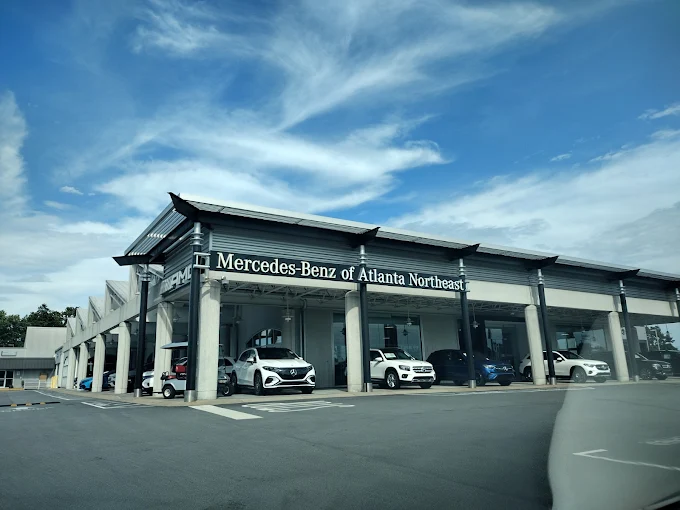
Service note: Mercedes-Benz of Atlanta Northeast's service center can be reached at 770-691-2339. Sharing your VIN when you call lets the team pull your model-specific service sheet before your arrival.
Schedule Your Summer Service Appointment
The Condition Is Now
A Mercedes-Benz that leaves the service center with verified coolant concentration, a load-tested battery, a fresh cabin filter, and correct tire pressure is ready for what Atlanta's summer actually delivers. Owners carrying families toward Don Carter State Park this summer will feel that thermal load multiplied by passenger count and cargo weight -- the same service logic applies, and the window to act before peak heat is right now.


