
EQE Winter Efficiency Guide for Gwinnett County | Mercedes-Benz of Atlanta Northeast
Posted at Tue, Nov 24, 2026 9:54 PM
You drive the EQE off the charger on a January morning, the display reads 285 miles, and you wonder whether that number is going to hold. It won't, not entirely. But the plain answer runs kinder than the Minnesota forum threads suggest. In Gwinnett County, where winter lows average around 31 degrees Fahrenheit and rarely stay there for long, the range hit you're planning around stays manageable.
Will the EQE's Range Hold Up Through a Gwinnett Winter?
The 2026 EQE 320+ Sedan holds up through a Gwinnett winter without much drama, rated at 308 miles on a full charge, with a 96 kWh battery pack and a Permanently Excited Synchronous motor producing 315 hp, though those are the numbers you'll see on a temperate day rather than a cold one. In cold weather, lithium-ion chemistry slows slightly, and cabin heating pulls from the same pack that moves the car. The result is a real but bounded reduction. Gwinnett County's average winter temperature sits at 44.6 degrees Fahrenheit across December through February, with January averages near 42.7 degrees. Cold enough to feel on the range display. Not cold enough to make the EQE impractical.
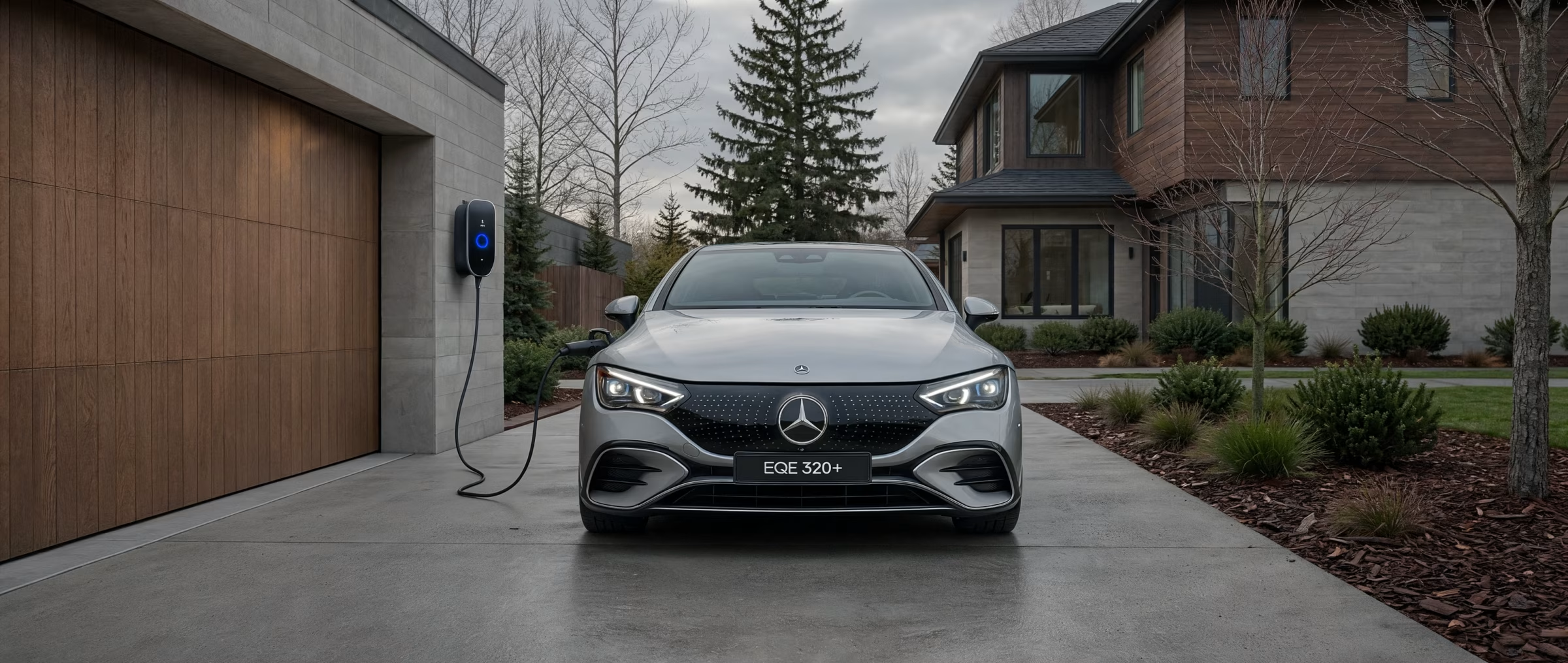
The EQE 320+ Sedan carries two specs that matter here. Its 170 kW DC fast charging recovers most of your range in a quick stop, and the 9.6 kW onboard AC charger fills the pack overnight at home. The tradeoff is real, and we'll give it to you plainly.
How Much Range Does Cold Weather Actually Take From the EQE in Gwinnett County?
Cold weather takes the practical winter floor for the EQE into the range of 230 to 245 miles on a fully charged battery during a cold snap, a reduction of roughly 20 to 25 percent from the rated 308 miles, which matches what owners report when overnight temps drop into the mid-to-upper 20s. For most Gwinnett County mornings, the reduction is less. About 84 percent of nights here stay above freezing entirely, so your daily wake-up range sits closer to the rated figure than to that worst-case floor.
One number reframes the whole conversation. The average round-trip commute in the Atlanta metro area runs well under 50 miles. Even at the winter floor, the EQE covers that more than four times over without touching a charger. The range isn't the constraint. Planning around the occasional overnight cold snap is.
How Do You Get the Most Efficiency From the EQE on Cold Gwinnett Mornings?
Pre-conditioning is the single highest-return habit for cold-weather electric driving in a climate like this one, and the EQE's MBUX system makes it straightforward, letting you warm the cabin and temper the battery while the car's still plugged into your home charger so that energy comes from the wall rather than the pack. You start the drive with a warmer battery and a warm cabin, and the number on the range display reflects a vehicle already working near its optimal thermal window.
Skip the pre-conditioning, and the first 10 to 15 minutes of driving spend pack energy on heating instead of motion (energy that would otherwise move the car). The habit costs you nothing beyond a tap in the app the night before.
The I-285 northbound corridor through the Duluth area, with its familiar stop-and-go between 4:30 and 6:30 PM, works in the EQE's favor during winter. If your commute includes that Perimeter crawl, you're recouping a portion of what cold weather costs you.
Regenerative braking recovers energy with every deceleration event. Highway cruising at speed draws more steadily from the battery with no recovery opportunity.
Where Can You Charge an EQE Around Gwinnett County This Winter?
You can charge the EQE across Gwinnett County at both Level 2 and DC fast stations, since the car supports the J1772 AC connector and the Combined Charging System, or CCS, standard for DC fast charging, and the corridor along I-85 and the I-285 interchange has added meaningful public fast-charging over the past two years. You don't need to plan a charging stop for a typical day of Gwinnett driving. Knowing your options for longer runs toward Lake Lanier via GA-400 or into downtown Atlanta is worth doing, though. If you ever have questions about your EQE's charging setup or battery management, scheduling a service appointment with our technicians is the fastest way to get answers specific to your vehicle.
Browse our current EQE inventory to confirm which charging equipment comes standard on the trim you're considering.
When Does Winter Efficiency in the EQE Become a Real Planning Consideration?
Winter efficiency becomes an active planning consideration only on your longer runs, because for ordinary Gwinnett County driving from December through February the 2026 EQE 320+ Sedan's cold-weather performance is no barrier at all, with the rated 308-mile range keeping a generous buffer even at the 20-to-25 percent winter reduction. Daily driving, the I-85 commute, a weekend run toward the mountains via GA-400 in a GLE or the EQE, the range covers all of it without drama.
The longer runs are where it turns into a planning factor. A round trip from Duluth to the North Georgia mountains via the Russell-Brasstown Scenic Byway, for example, pushes into genuine charging-stop territory on a cold day, particularly because the elevation gain and cold combine to draw more from the pack. Call it the honest boundary. Know it, plan for it, and the EQE is a confident four-season vehicle for this climate.
Frequently Asked Questions About EQE Winter Efficiency in Gwinnett County
Does the Mercedes-Benz EQE have a heat pump for cold-weather efficiency?
The 2026 EQE 320+ Sedan uses a heat pump to warm the cabin in cold conditions, drawing significantly less energy from the battery pack than a resistive heater would. That efficiency is one reason the EQE's cold-weather range reduction in a mild climate like Gwinnett County's stays more moderate than what owners in colder northern climates report. The heat pump works best when ambient temperatures stay above roughly 14 degrees Fahrenheit, which covers nearly every Gwinnett winter day.
How fast does the Mercedes-Benz EQE charge in cold weather at DC fast-charging stations?
DC fast charging at up to 170 kW is the EQE's ceiling under optimal conditions. In very cold weather, the battery management system may limit charging speed briefly while the pack warms to its efficient temperature window. In Gwinnett County's typical winter range, with daytime highs in the low 50s, that thermal conditioning period is short. A 10-to-80 percent charge, completed in about 32 minutes under good conditions, may take a few minutes longer on the coldest mornings.
Should I charge the EQE to 100 percent the night before a cold Gwinnett winter day?
For most daily driving in Gwinnett County, charging to 80 percent overnight is the standard recommendation for long-term battery health. If you know the next morning'll be particularly cold, say with overnight lows forecast in the low 20s, charging to 90 or 95 percent gives you a meaningful cushion. Pre-conditioning the cabin before you unplug also recovers several miles of effective range by warming the battery on grid power rather than pack power.
Does the EQE's range improve in Gwinnett County stop-and-go versus highway driving in winter?
It depends on speed. In the moderate stop-and-go of I-285 and I-85, the EQE's regenerative braking system recaptures energy with each deceleration, partially offsetting the cabin-heating draw. Steady highway driving at 65 to 75 mph with no recovery events is typically harder on winter range. Drivers whose commute mixes Gwinnett County surface streets with brief highway segments often see better real-world winter efficiency than pure-highway drivers.
Is the EQE a practical daily driver for Gwinnett County residents in winter?
Our finance team can walk you through this question, and the answer's yes for the vast majority of Gwinnett County driving patterns. Gwinnett's winter is classified as a mild humid subtropical climate, with average December-through-February temperatures hovering around 44.6 degrees Fahrenheit and about 84 percent of nights staying above the freezing mark. The EQE 320+ Sedan's cold-weather range remains well above what a typical Atlanta-area commute requires. The vehicle becomes a planning conversation, not a limitation, only on longer mountain runs on the coldest days. By the Mercedes-Benz of Atlanta Northeast Team | November 2026


