

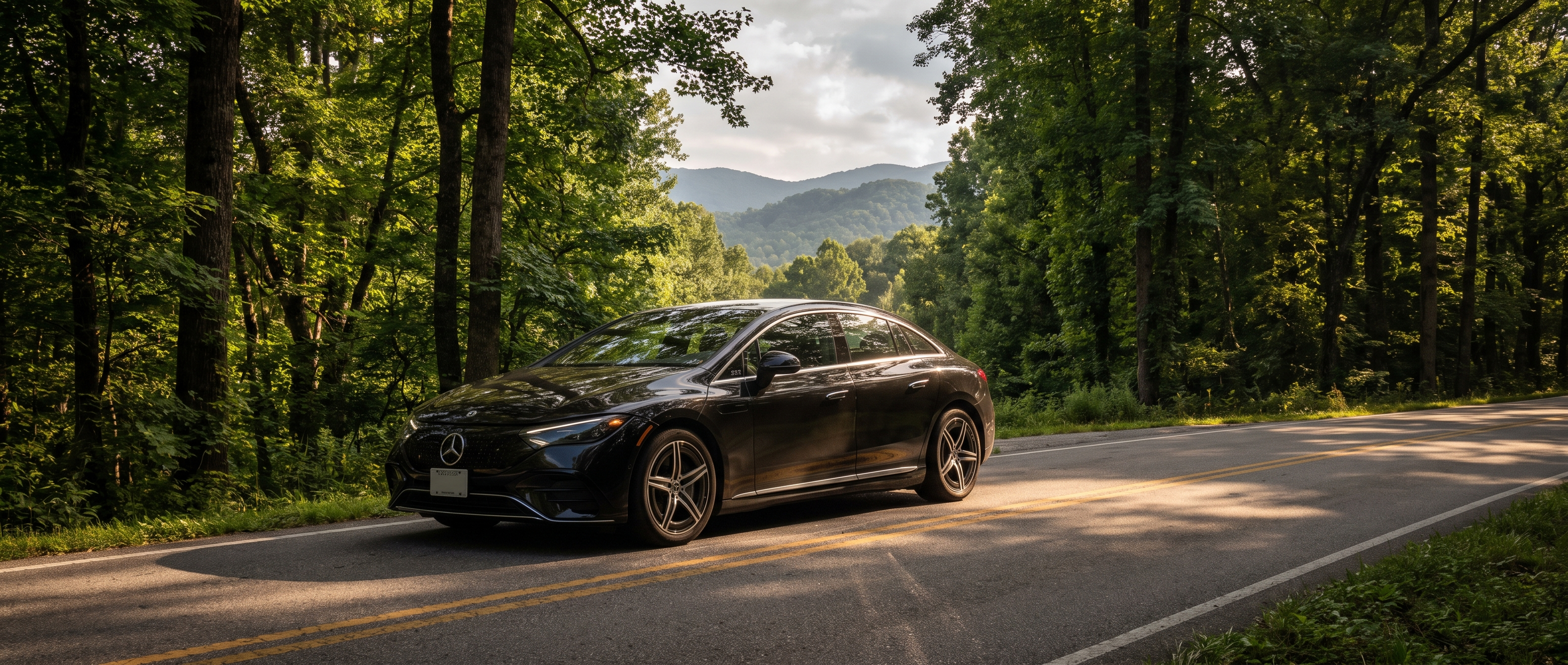
EQE 320+ vs 320 4MATIC: Blue Ridge Weekend Trips from Duluth
Posted at Fri, Jul 10, 2026 1:19 AM
The round trip from Duluth to Blue Ridge and back runs about 155 to 158 miles. The 2026 Mercedes-Benz EQE 320+ carries an EPA-rated 308 miles of range. The math says you can make the mountain run and return home without stopping to charge -- and the 4MATIC version, with its shorter rated range, gets there just as comfortably. The real question is not whether either trim can handle the drive. It is which one handles it better, and why that answer is not as simple as range alone.
Browse the 2026 EQ lineup at Mercedes-Benz of Atlanta Northeast
The short version
- Both the EQE 320+ and EQE 320 4MATIC complete the Duluth-to-Blue Ridge round trip without a charging stop, assuming a solid departure charge.
- The 320+ (RWD, 308 miles EPA) gives you more range cushion and roughly 40 additional rated miles over the 320 4MATIC (AWD, approximately 267 miles EPA).
- The 320 4MATIC's all-wheel drive delivers added confidence on steep mountain grades, rain-slick mountain roads, and the kind of tight switchbacks you find near the Russell-Brasstown Scenic Byway.
- Regenerative braking on mountain descents partially offsets the AWD range penalty for the return leg.
- For the Duluth driver who stays on the mountain most of the weekend, hotel-level charging (Level 2) overnight is the cleanest strategy either way -- the 2026 EQE charges at up to 11 kW on AC, and a single overnight session restores meaningful range.
What's the Real Difference Between These Two Trims?
Strip away the marketing and the 2026 EQE lineup comes down to one meaningful powertrain choice: rear-wheel drive with a larger battery and more range, or all-wheel drive with enhanced traction and a shorter range ceiling. Mercedes-Benz lists the 2026 EQE 320+ -- the RWD model -- at 308 miles EPA-rated range from its 96 kWh battery, with 315 horsepower and 416 lb-ft of torque. The EQE 320 4MATIC pairs a second front motor with the same 315 horsepower output but raises torque to 564 lb-ft through dual-motor AWD -- at the cost of a smaller 90.5 kWh battery and an EPA range figure that drops to approximately 267 miles.
Both trims share the same DC fast-charging hardware: up to 170 to 173 kW peak, with a 10-to-80 percent charge taking approximately 32 minutes on a capable station. The 2026 model year adds a standard NACS adapter, which means both trims can use the Tesla Supercharger network anywhere along GA-400 or through Dawsonville -- a meaningful expansion of en-route options that simply was not available on earlier EQE model years.
| Feature | EQE 320+ (RWD) | EQE 320 4MATIC (AWD) |
|---|---|---|
| EPA Range | 308 miles | ~267 miles |
| Battery | 96 kWh | 90.5 kWh |
| Power | 315 hp / 416 lb-ft | 315 hp / 564 lb-ft |
| Drivetrain | Rear-wheel drive | All-wheel drive |
| 10-80% DC Fast Charge | ~32 minutes | ~32 minutes |
| 0-60 mph | 5.8 seconds | ~5.5 seconds |
| Mountain Grade Traction | Good | Better |
| Regen Braking (descent) | Yes | Yes |
| NACS Adapter (2026) | Standard | Standard |
| Best for Blue Ridge Run | Range cushion, dry roads | Wet roads, winter, maximum confidence |
The 320+ wins on range; the 4MATIC wins on traction. For most summer weekend runs from Duluth to Blue Ridge, the 320+ arrives with 150-plus miles of range to spare -- but the 4MATIC's AWD becomes the decisive factor the moment the mountain roads get wet.
Does the Mountain Drive to Blue Ridge Actually Stress the Battery?
Driving north on GA-400 through Dahlonega and into Fannin County is a sustained climb. Blue Ridge sits at roughly 1,700 feet of elevation. The Russell-Brasstown Scenic Byway, if you detour for Brasstown Bald, takes you to nearly 4,784 feet -- Georgia's highest point. Elevation gain consumes battery energy, and the EQE's battery management system works harder on sustained grades than on flat interstate.
That said, the gain is modest in the context of the EQE's 308-mile rated range. What the mountains give back is regenerative braking on the descent: the EQE's regen system captures energy during deceleration and feeds it back into the pack. A long, winding descent from Brasstown Bald or along the scenic byway means the return leg to Duluth often starts with a state of charge meaningfully higher than drivers expect after the ascent.
The 4MATIC's AWD also distributes torque more aggressively across steep grades -- which can matter less for energy consumption than for confidence. The 320 4MATIC accelerates to 60 mph approximately 0.3 seconds faster than the 320+, which translates on mountain roads into more composed power delivery on switchbacks and grades, not just raw speed.
The EQE shares its market position with the combustion E-Class but rides on a dedicated electric platform that gives it a lower center of gravity than most sedans -- a characteristic that serves mountain driving well regardless of which trim you choose.
In summer heat (July and August in North Georgia regularly see mid-90s temperatures along the valley floors), both trims benefit from starting the drive with the battery pre-conditioned. The EQE's navigation system, when set to a DC fast charger as a waypoint, begins warming or cooling the pack before arrival. For the Duluth driver heading north on a July weekend, setting Dahlonega or Dawsonville as a nav stop -- even briefly -- cues the system to manage pack temperature for optimal performance on the mountain sections that follow.
Planning the Charge -- Before You Leave, Not Along the Way
The cleanest strategy for a Blue Ridge weekend in either EQE trim does not involve a DC fast-charging stop at all. It involves the night before.
Charge to 90 to 100 percent the evening before departure. The EQE's charging settings allow you to set a daily limit (Mercedes-Benz recommends keeping the battery between 20 and 80 percent for daily use) and a trip-eve override. Set the override, wake up with a full pack, and the 77 to 79 miles to Blue Ridge consumes roughly 25 to 27 percent of the 320+'s rated capacity. The return drive adds another 25 to 27 percent. You arrive home in Duluth with 45 to 50 percent of range remaining -- more than enough for a day of driving the following week without plugging in until convenient.
For the 4MATIC, the same departure math works but leaves a narrower cushion: roughly 50 to 55 percent consumed for the round trip, arriving home in Duluth at 45 to 50 percent on a full departure charge. Still entirely comfortable, though the buffer is smaller.
If you stay overnight in Blue Ridge and your cabin or hotel has a Level 2 outlet or charger, the calculus simplifies further. The Hampton Inn in Blue Ridge (50 West Main Street) offers AmpUp Level 2 charging. The EQE draws up to 11 kW on AC Level 2, adding roughly 35 miles of range per hour -- a full overnight session from 40 percent fully restores the pack for the drive home. Several vacation rental cabins in the Blue Ridge area have also added Level 2 outlets, making it worth asking at booking.
Explore financing options for the 2026 EQE
Pre-trip tip: Set your navigation to a destination in Blue Ridge before leaving Duluth, not after. The EQE's MBUX system reads your route, estimated state of charge, and terrain to calculate whether a charging stop is needed -- and if you have pre-conditioned the battery at 90-plus percent, it will confirm what the math suggests: you have more than enough range to enjoy the drive without stopping. Use the 20-minute segment on GA-400 before Dawsonville to let the system warm the pack, particularly if departing early in the morning when July temperatures are still in the 70s.
So Which Trim Should You Choose for the Mountains?
The buyer profile makes this decision straightforward in most cases.
The EQE 320+ fits the Duluth driver who runs to Blue Ridge on dry summer weekends, values the maximum range buffer, and prefers the quieter, rear-wheel-drive character at highway speeds on GA-400. The extra 40-plus miles of rated range function as peace of mind, not a practical necessity on a 155-mile round trip -- but that cushion grows meaningful if you also use the EQE for longer Georgia runs to Savannah, Chattanooga, or the coast. The 320+ is the better choice if the mountain run is one of several uses, not the only one.
The EQE 320 4MATIC fits the driver who goes to the mountains in any season -- or who extends the trip onto the Russell-Brasstown Scenic Byway, where one-lane passes and steep grades reward every ounce of traction the AWD system provides. It also fits drivers who simply prefer knowing the front axle is engaged during a rain event, which North Georgia summers produce reliably from July through September. If your Blue Ridge weekends extend into fall or winter, when Fannin County roads occasionally ice at elevation, the 4MATIC eliminates a calculation you would otherwise have to make every single trip.
Drivers who prioritize mountain AWD confidence across a range of conditions also consider the GLE, which brings a different scale of capability for the same North Georgia runs.
Neither choice requires compromise on the core EQE experience: the nearly silent cabin, the MBUX Hyperscreen option, multi-contour front seats, and the 12.8-inch OLED touchscreen are available on both trims. The mountain drive becomes a setting for the car, not a test of it.
Frequently Asked Questions
Does the 2026 EQE need a charging stop between Duluth and Blue Ridge?
No. The round trip from Duluth to Blue Ridge and back runs approximately 155 to 158 miles. The EQE 320+'s EPA-rated 308 miles of range covers that distance with over 150 miles of cushion, assuming you depart with 90 to 100 percent charge. The EQE 320 4MATIC, rated at approximately 267 miles, completes the same round trip with roughly 110 miles of rated range to spare. Neither trim requires a DC fast-charging stop along GA-400 or in Blue Ridge itself for a standard out-and-back weekend run.
What charging is actually available in Blue Ridge, GA?
DC fast charging options in Blue Ridge are limited. The most accessible public charging in town is Level 2: the Hampton Inn at 50 West Main Street offers AmpUp plugs, and a small number of vacation rental cabins have added Level 2 outlets for guests. For DC fast charging, the stronger network options are along the GA-400 corridor near Dawsonville and Dahlonega -- both roughly 30 to 40 miles south of Blue Ridge -- which are well-served and accessible if you want to top up before the final mountain segment. The 2026 EQE's standard NACS adapter also provides access to Tesla Supercharger stations wherever those are present along the route.


