

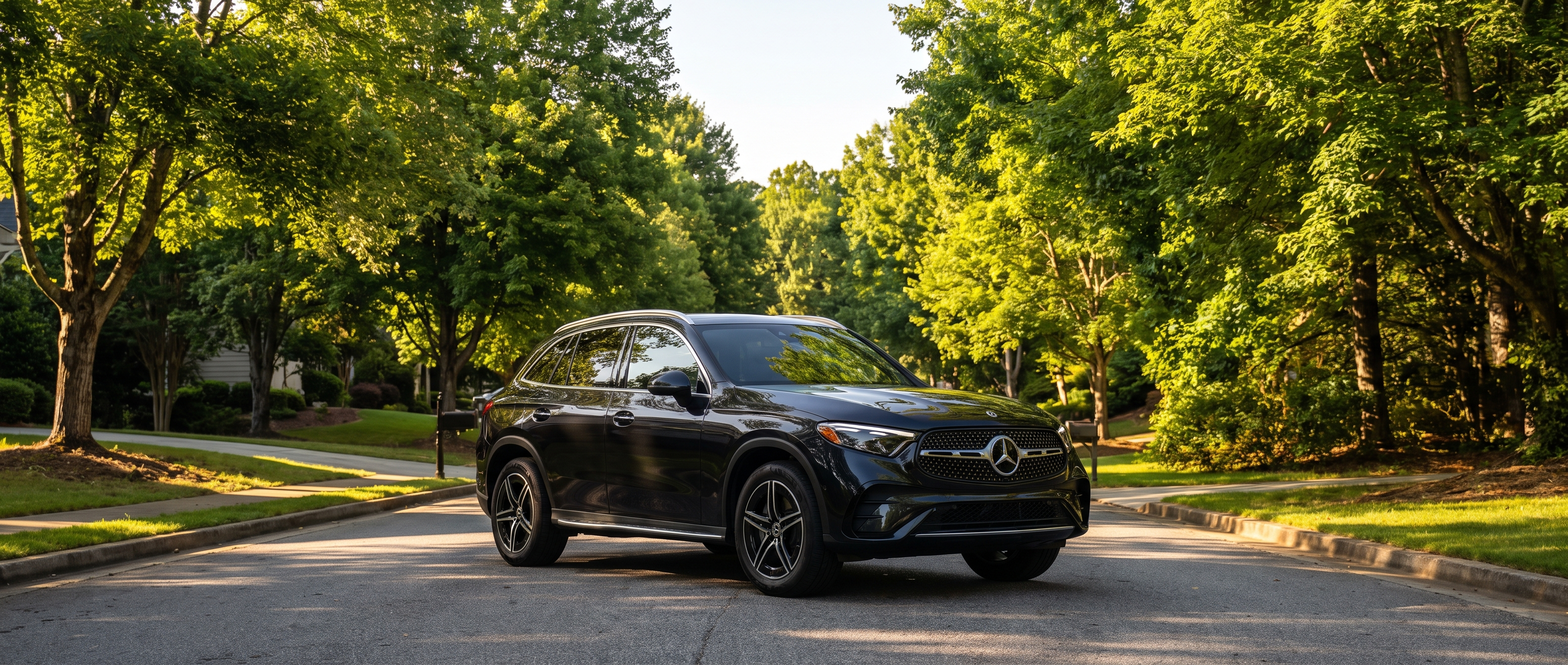
2 Mercedes-Benz Models for Duluth Daily Driving: C-Class vs GLC 300
Posted at Wed, Jul 15, 2026 1:30 AM
Here is the short answer: the 2026 C-Class C 300 is the stronger choice for drivers who prize sedan dynamics and wringing every mile out of a tank on I-285. The 2026 GLC 300 earns its rank for anyone who needs real cargo room, wants a higher driving position, or plans to run up GA-400 to the mountains on weekends. Both share the same 255-horsepower turbocharged engine and the same platform -- the decision between them is almost entirely about how you use the vehicle, not how it performs.
The Head-to-Head Ranking
This table is built around the question Duluth drivers actually face: which vehicle holds up best across a five-day Atlanta commute and still earns its keep on Saturday?
| Rank | Pick | Best For | Standout Spec |
|---|---|---|---|
| 1 | 2026 C-Class C 300 | Executive commuter who values driving refinement and fuel efficiency | EPA-rated 29 mpg combined (RWD); 11.9" MBUX touchscreen standard |
| 2 | 2026 GLC 300 | Driver who needs versatile cargo room and a higher seating position | 21.9 cu ft behind the rear seats; 56.3 cu ft seats folded |
Rank 1 -- The 2026 C-Class for the Duluth Commuter
Stop-and-go on I-285 northbound between 4:30 and 6:30 PM is not a minor inconvenience -- it is a daily feature of life in Gwinnett County. The C-Class is engineered for exactly this environment: a 2.0-liter turbocharged inline-four with a 48-volt mild-hybrid system that delivers 255 horsepower and 295 lb-ft of torque, paired with a nine-speed automatic transmission. Mercedes-Benz rates the rear-wheel-drive C 300 at 25 city / 35 highway -- a combined 29 mpg by EPA estimates -- which is meaningful over a 40-plus mile round trip on I-85 and the Perimeter.
Explore the 2026 C-Class at Mercedes-Benz of Atlanta Northeast
The sedan's lower center of gravity translates into handling that is noticeably sharper than the GLC's on quick lane changes, and the cabin is quiet enough that road noise on the concrete sections of I-285 barely registers. Inside, every C 300 comes standard with a 12.3-inch digital instrument cluster and the 11.9-inch portrait-orientation MBUX touchscreen. For a driver who spends an hour each day behind the wheel, those are not optional comforts -- they are the environment.
The 2026 C-Class C 300 with rear-wheel drive earns an EPA-estimated 29 mpg combined, making it the most fuel-efficient non-hybrid model in Mercedes-Benz's lineup for sedan drivers.
The trunk measures 11.6 cubic feet. That is adequate for a week's worth of work travel -- a roller bag and a briefcase clear it comfortably -- but it is a fixed constraint. If your trunk needs grow on weekends, that number matters.
Buying caution: The C 300 is available in rear-wheel drive or 4MATIC all-wheel drive. Georgia's summer thunderstorms can briefly flood low sections of Buford Highway and I-85. For most Duluth drivers, standard rain-sensing wipers and driver-assistance systems handle wet roads well in RWD form. If you frequently drive in those conditions with a heavier load, the 4MATIC variant (EPA-rated 24 city / 33 highway) adds grip at the cost of two miles per gallon.
Rank 2 -- The 2026 GLC 300 for the Versatile Duluth Driver
The C-Class and the GLC 300 share the same turbocharged 2.0-liter engine and the same MHA platform -- a fact that surprises many buyers who expect a large mechanical gap between a compact sedan and a compact SUV. They do not. Both produce 255 horsepower and 295 lb-ft. The GLC's 0-to-60 of 5.9 seconds (per Mercedes-Benz) is actually a tenth quicker than the C-Class's 6.0-second figure, largely because the GLC's mild-hybrid Integrated Starter-Generator delivers boost off the line more aggressively at lower speeds.
See the 2026 GLC 300 inventory at Mercedes-Benz of Atlanta Northeast
What separates the GLC is the body: 21.9 cubic feet of cargo space behind the rear seats, expanding to 56.3 cubic feet when you fold the 40/20/40 split-rear-seat configuration flat. For a driver who visits Don Carter State Park or Lake Lanier on weekends with kayak gear, a cooler, and a folded canopy, that difference versus the C-Class's 11.6-cubic-foot trunk is decisive. The higher seating position also provides better sightlines on the congested stretch of I-85 through Duluth, where traffic backs up from 7:00 to 9:00 AM.
The GLC 300 is EPA-rated at 24 city / 32 highway in base rear-wheel-drive form, or 23 city / 31 highway with 4MATIC. That is two to three mpg less combined than the C-Class -- a real difference over time but not a disqualifying one for a driver who values what the additional cargo room provides.
The GLC's third-generation MBUX system includes a feature called MBUX Routines, which automates climate, audio, and navigation preferences based on location and time of day. On a repeating commute, it learns your I-285 pattern and adjusts accordingly.
- Cargo expands from 21.9 to 56.3 cu ft via the 40/20/40 split-fold rear seat
- 4MATIC all-wheel drive standard on upper trims; optional on GLC 300
- MBUX Routines adapts to location and time for a personalized daily experience
- Higher seating position improves sightlines in heavy I-85 and I-285 traffic
- GLC 350e PHEV option adds an EPA-estimated 54 miles of electric-only range
View Current Mercedes-Benz Specials
The Verdict: Which One Actually Fits Your Week
If your week is primarily a commute -- I-285, I-85, Buford Highway, a parking garage in Midtown or Buckhead -- and your weekends are light, the C-Class's driving refinement and superior fuel efficiency give it a clear edge. It rewards the driver who wants to feel the road and return fewer times to the pump.
If your week combines that same commute with a Saturday run up GA-400 toward Dahlonega or a Sunday afternoon at Lake Lanier where you load and unload gear, the GLC 300 earns its rank without demanding a performance compromise. You are not trading away the sedan's engine or technology -- you are gaining space and a higher vantage point.
Both are current-generation vehicles built on the same architecture, with the same MBUX technology, the same mild-hybrid drivetrain, and the same standard safety systems. The choice is almost entirely a lifestyle question. Schedule some time with the team at Mercedes-Benz of Atlanta Northeast -- a drive in both back-to-back on Duluth roads settles it faster than any comparison article.


